Yesterday hubby and I went to a string quartet concert...and as is usual for me, I spent almost the entire time thinking about writing. For some reason the classical music starts, I listen closely for about 5 minutes, and then my mind drifts. It's not that I don't like the music--I love it--it's just...I'm not sure exactly. Somehow no matter the composer, live classical music puts me firmly in the medieval mindset, and I happily daydream about plot and characters, and imagine scenes. It's quite productive, actually, although I don't write anything down.
Isabella (Isabel? Bella? I'm not sure yet) was very present in my mind yesterday. She's the youngest of 3 princesses, and apparently is rather more outspoken than her sisters--and less worried about consequences, and appearances. This should be fun.
I also realized, though, that this book will be quite a bit more challenging than TMT in terms of structure. My MC is a real-life historical character, and I can't just make her do whatever the heck I/she wants to do. We have a basic script we need to work within: major events, locations, when her children were born, when she died...I have a lot of freedom with this character, since she's not well-recorded as far as I know, but I also have restrictions Katherine didn't come with.
I also have to figure out how to make, or find, a story arc WITHIN her lifetime story. I've already discarded the usual plot devices historical fiction writers use to frame, because they ARE usual. No, she will not be telling her story to a monk at the end of her life. No, she will not be on her deathbed gasping the tale to a favorite grandchild. I also don't particularly want to just--poof--end the story at her death, and that's it.
My current plan is to research the main facts as well as I possibly can, then just start writing and see where it takes me. Trust in the process, as I did with TMT. Trust that the real story, the one under the facts, the whole arc, will come alive in the writing. Then we'll see what Isabella really has to tell.
Medieval Word of the Day: stubble-goose: A goose fed on the stubble. (c1386 CHAUCER Cook's Prol. 27 For of thy percely yet they fare the wors That they han eten with thy stubbel goos. 1708 W. KING Art of Cookery 77 So stubble Geese at Michaelmas are seen Upon the spit, next May produces green. 1816 W. TAYLOR in Monthly Mag. XLII. 37 Geese..are eaten young, under the name of green geese,..They are eaten adult, under the name of stubble geese.)
Monday, July 10, 2006

Friday, July 07, 2006
The Village Approach to Publishing
Ooooh. Agent Jennifer Jackson just posted an excellent essay called "The I in Team" over on Romancing the Blog, about the entire crew involved in making a book successful. Go check it out and absorb it!
Making the Connection
Yesterday I started in on the research for Book 2--I went to the campus library and got some general 14th-century overviews to bone up on John of Gaunt and all the political shenanigans that were going on. Oh, and ordered "John of Gaunt, King of Castile and Leon, Duke of Aquitaine and Lancaster, Earl of Derby, Lincoln, and Leicester, Seneschal of England". (Have I said how much I love interlibrary loan?) I started making a list of all the characters I want to include and investigate, and noting down intriguing plot points.
And I hit paydirt right away, in the first book. Woo-hooo! I came across a historical notation that my two main characters were involved in a huge, dramatic (traumatic) event with their father when they were 11 and 12. It has the makings of an excellent beginning, would start with action AND set the scene for all that comes later. And it would pull the readers right in. Heck, it pulled me right in to the research book. I got all giddy.
I also had a rather odd sensation that I've experienced before a few times; I wonder if you have.
I'm still deciding which of the two sisters will be my main POV character. I think I know, but I haven't quite committed yet. As I was reading last night I had the strangest feeling that I was really watching this event happen. I was there, just hovering over them like a spirit. More, I knew that I could choose one of them and slip into her skin, inhabit her, see her life through her eyes. I could feel them, and their interest. Was this one more receptive to me? Did this one want to tell her story more than the other?
I do wonder sometimes about this connection, in writing historical fiction, between the writer and the character/historical figure. I wonder if we travel in time through our minds, somehow. I wonder if we are ghosts to them, or they are to us. I wonder how many of those eerily correct hints and guesses we make are real.
Anyway, I'm excited about the new book. If it comes together like it is shaping already in my mind, it will be fabulous. Oh, and Isabella is the one who wants to talk to me so far...so we'll keep on with the research and see where that goes.
Medieval Word of the Day: louke: a boon companion.
And I hit paydirt right away, in the first book. Woo-hooo! I came across a historical notation that my two main characters were involved in a huge, dramatic (traumatic) event with their father when they were 11 and 12. It has the makings of an excellent beginning, would start with action AND set the scene for all that comes later. And it would pull the readers right in. Heck, it pulled me right in to the research book. I got all giddy.
I also had a rather odd sensation that I've experienced before a few times; I wonder if you have.
I'm still deciding which of the two sisters will be my main POV character. I think I know, but I haven't quite committed yet. As I was reading last night I had the strangest feeling that I was really watching this event happen. I was there, just hovering over them like a spirit. More, I knew that I could choose one of them and slip into her skin, inhabit her, see her life through her eyes. I could feel them, and their interest. Was this one more receptive to me? Did this one want to tell her story more than the other?
I do wonder sometimes about this connection, in writing historical fiction, between the writer and the character/historical figure. I wonder if we travel in time through our minds, somehow. I wonder if we are ghosts to them, or they are to us. I wonder how many of those eerily correct hints and guesses we make are real.
Anyway, I'm excited about the new book. If it comes together like it is shaping already in my mind, it will be fabulous. Oh, and Isabella is the one who wants to talk to me so far...so we'll keep on with the research and see where that goes.
Medieval Word of the Day: louke: a boon companion.
Thursday, July 06, 2006
Loot
I was going to do a craft post today, but Vicki distracted me with writer T-shirts. So now all you're gonna get are cool T-shirt links.
The Muwahahahaha writer's shirt
Off the Villain writer's shirt
Geeky Medieval Richard II shirt
Perhaps tomorrow I will talk about actual writing and such.
Medieval Word of the Day: sweven: A dream, vision.
The Muwahahahaha writer's shirt
Off the Villain writer's shirt
Geeky Medieval Richard II shirt
Perhaps tomorrow I will talk about actual writing and such.
Medieval Word of the Day: sweven: A dream, vision.
Wednesday, July 05, 2006
Fireworks and the 4th

When I was small, fireworks were a scary thing.
My mom thought they were scary, so I did too. My mom thought they were too loud, so I did too. She had been in the path of a stray firecracker when she was 10, and had lost some of her hearing as a result--her fear was real and based in experience, and my dad's tepid enthusiasm could not stand against it. Then personal fireworks began to become illegal in California anyway. My mom was relieved, and I didn't mind too much.
When I married we still lived in California, so we didn't do our own. We dutifully went to the local show, oohed and aahed, and went home.
Then we moved to the Fireworks Capital, here in Montana. And my husband, along with nearly every other man and many women here, fell in love with fireworks. Just about everything is legal here. You can do rockets, professional-looking blasts that fill the sky, shapes, fireworks that twist and twirl and zoom and BOOM and...
Man, he has fun. And my mom and stepdad moved here too, and my stepdad has joined in with full vigor. And my mom? She still doesn't like them. She still puts her hands over her ears, even for the little ones. But somehow along the way I've managed to shed her fears, and I don't think I ever really had any of my own. I sit with my daughter and laugh when the big ones go off just above us, cheer when Daddy and Opa set their tandem rockets just right, and oooh and aaah all night.
Hope you had a wonderful 4th of July.
Medieval Word of the Day: falding: A kind of coarse woollen cloth; frieze.
Monday, July 03, 2006
The Nasty Reviews
Rosina Lippi (also known as Sara Donati) has an interesting post up today about reading your own reviews--the overwhelming to urge to do it and the inevitable reaction, to focus on the negative ones and skip over the positives.
Apparently neither of these things go away as you progress up the writing career path. {sigh}
I know already that I am struck with this weakness. Say I get 5 critiques of a chapter: 4 say some variation of "OMG, I loved it!" and 1 says "I thought it was a little weak on the dialogue". I will so skip right over the 4 and obsess about the dialogue, if I let myself.
That's the secret, and Rosina knows it too. You can't let yourself do that, or you'll go crazy. It all goes back to the "Listen and Reflect" method. I'm not saying you should ignore bad reviews or critiques if they strike a chord with you after some distance.
Of course it may be different when/if (let's go back to a positive when) my book is published. The scale is so much grander. Instead of 10 people reading my book, it could be a thousand. It would be so easy, in a spare moment, to pop over to Amazon and see what those readers, those new minds encountering my words, were saying. I probably wouldn't be able to resist the call either. I just hope I would be able to keep my head, and my perspective, intact...
Medieval Word of the Day: archwife: ‘A wife of a superior order’ (Tyrwhitt); a strong or masterful wife, a virago (‘Mannweib’ Mätzner).
Apparently neither of these things go away as you progress up the writing career path. {sigh}
I know already that I am struck with this weakness. Say I get 5 critiques of a chapter: 4 say some variation of "OMG, I loved it!" and 1 says "I thought it was a little weak on the dialogue". I will so skip right over the 4 and obsess about the dialogue, if I let myself.
That's the secret, and Rosina knows it too. You can't let yourself do that, or you'll go crazy. It all goes back to the "Listen and Reflect" method. I'm not saying you should ignore bad reviews or critiques if they strike a chord with you after some distance.
Of course it may be different when/if (let's go back to a positive when) my book is published. The scale is so much grander. Instead of 10 people reading my book, it could be a thousand. It would be so easy, in a spare moment, to pop over to Amazon and see what those readers, those new minds encountering my words, were saying. I probably wouldn't be able to resist the call either. I just hope I would be able to keep my head, and my perspective, intact...
Medieval Word of the Day: archwife: ‘A wife of a superior order’ (Tyrwhitt); a strong or masterful wife, a virago (‘Mannweib’ Mätzner).
Friday, June 30, 2006
Oh, dear.
In our house we have a strong rule against Child turning around and sitting sideways or backwards in her chair at meals...it creates grubby chairs, not to mention distraction from food.
However, Child is a slow eater like most preschoolers, and there are many times when I go and clean up the kitchen (behind her) while she's still finishing up. She has trouble "remembering" this rule.
Last night I had to tell her (again) to turn around and finish up. "You know the rule," I said in my best Mommy-voice.
"But Mommy," she responded, without a beat. "I just had to turn and look at you. You look so nice in that shirt." {blink, blink}
OMG, I am SO in trouble. She's 4. If she already knows how to distract with compliments....
Medieval Word of the Day: forstraught: Distracted.
However, Child is a slow eater like most preschoolers, and there are many times when I go and clean up the kitchen (behind her) while she's still finishing up. She has trouble "remembering" this rule.
Last night I had to tell her (again) to turn around and finish up. "You know the rule," I said in my best Mommy-voice.
"But Mommy," she responded, without a beat. "I just had to turn and look at you. You look so nice in that shirt." {blink, blink}
OMG, I am SO in trouble. She's 4. If she already knows how to distract with compliments....
Medieval Word of the Day: forstraught: Distracted.
Thursday, June 29, 2006
Follow the Bouncing Paragraph
Poking around in my old files yesterday made me think of a post on editing, and how one task--the introduction and description of a character--can change from version to version. Come along as I Follow the Paragraph (okay, sometimes paragraphs) introducing Thomas, the love interest at the beginning of the story...
From TMT January 15, 2003 (as far back as I have here). The mss was then called TRUST.
(oh, should say that all excerpts, as ghastly as some of them are, are copyright Susan Adrian, 2006, All Rights Reserved)
--I studied him, trying to be objective. He was a big man, long of leg and tall in stature, with a wide chest. I thought he looked a bit like a fox, with dark red hair curling back from a high forehead, and a red beard surrounding a soft mouth. His nose was long and narrow, but any sharpness this brought to his face was tempered by deep brown eyes with thick eyelashes. Those eyes locked on mine again now, and he nodded almost imperceptibly.--
Ack. This sounds awfully cliched now, especially the sharpness "tempered by deep brown eyes". Yuck. It also wasn't quite what I wanted, anyway...the wide chest was wrong. And looking at it now, that's a boring paragraph, with just description and no action other than studying and eyes locking {gag}.
From TMT November 2003, so 10 months later:
I took it out! This is now the only description I have in the whole scene. Now all we know is that he has white teeth and a red beard and hair. Hmmm. Action is better, though I now have an overtly self-aware line (running a hand through my damp, tangled hair) that's out of place. I think I need to put more description back.
From TMT February 2004 (3 months later):
That's just one description. Multiply that times...oh, 75,000 (there are 95,000 words) and you'll understand, if you didn't already, exactly why it takes so long to write a book.
Medieval Word of the Day: pythonissa: Often treated as proper name of the witch of Endor. (yeah, baby. I've got to get the witch of Endor in Book 2.)
From TMT January 15, 2003 (as far back as I have here). The mss was then called TRUST.
(oh, should say that all excerpts, as ghastly as some of them are, are copyright Susan Adrian, 2006, All Rights Reserved)
--I studied him, trying to be objective. He was a big man, long of leg and tall in stature, with a wide chest. I thought he looked a bit like a fox, with dark red hair curling back from a high forehead, and a red beard surrounding a soft mouth. His nose was long and narrow, but any sharpness this brought to his face was tempered by deep brown eyes with thick eyelashes. Those eyes locked on mine again now, and he nodded almost imperceptibly.--
Ack. This sounds awfully cliched now, especially the sharpness "tempered by deep brown eyes". Yuck. It also wasn't quite what I wanted, anyway...the wide chest was wrong. And looking at it now, that's a boring paragraph, with just description and no action other than studying and eyes locking {gag}.
From TMT November 2003, so 10 months later:
--"Katherine!" Thomas looked up and smiled, his teeth white through the russet beard. I fumbled with the ties of my cloak, my cold, numb fingers slipping against the knot. Finally it broke free and I pulled off the cloak, hung the dripping mess on a peg, and tripped my way over to Thomas. He folded his arm around my shoulder. "God's blood, but you're wet!" he exclaimed, pulling back.
I took it out! This is now the only description I have in the whole scene. Now all we know is that he has white teeth and a red beard and hair. Hmmm. Action is better, though I now have an overtly self-aware line (running a hand through my damp, tangled hair) that's out of place. I think I need to put more description back.
From TMT February 2004 (3 months later):
--"Katherine!" He smiled, his teeth white through the russet beard. I always thought he looked a bit like a fox, with his long, narrow nose, dark red hair curling back from a high forehead, and short red beard. I fumbled with the ties of my cloak, my cold, numb fingers slipping against the knot. Finally it broke free and I pulled off the cloak, hung the dripping mess on a peg by the door, and tripped my way to Thomas. He draped an arm over my shoulder. "God's blood, but you're wet!" he exclaimed, pulling back and brushing a bit at his sleeve.
"I know! It is truly the flood, I think." I ran a hand through my damp, tangled hair, just looking at him. Even in the weak gray light from the window his hair and beard were a fire of red, his dark eyes gleaming. "Next we shall look out the window and see a line of animals, two by two."--
Interesting. I added the fox part back in--this actually becomes a recurring metaphor in the book. I've added in the "brushing a bit at his sleeve" to begin to show his fussiness about his appearance. Kept all that last paragraph, though.
By July 2004 I'd taken out the self-aware line (made it "I ran a hand over my damp skirt", which is better) but left the rest the same.
Fast-forward to October 2005:
--"Katherine!" He smiled, his teeth white through the russet beard. I always thought he looked a bit like a fox, with a long, narrow nose, dark red hair curling back from a high forehead, and short red beard. I fumbled with the ties of my cloak, my cold, numb fingers slipping against the knot. Finally it broke free and I hung the dripping mess on a peg by the door, tripping my way to Thomas. He draped an arm over my shoulder.
Tired of it yet? Welcome to editing. I wonder how many times I've read this paragraph. Anyway, here I broke out his speech and movement, took out the "bit" from him brushing his sleeve, and changed Katherine's "I know" to "Aye", which she consistently uses. Oh, and finally went back and researched head coverings, and added a veil.
One more. Here's the "final" version. I finally realized it would be better to move that fox line to the part where she's looking at him. You'll see some of the dialogue has changed too, and the actions are a bit different.
--Thomas stood alone by the window, leaning over a table covered with sheets of parchment. He set down his quill and smiled, his teeth white through the russet beard.
"Katherine, my pet!"
I fumbled with the ties of my cloak, my cold, numb fingers slipping against the knot until it broke free. I hung the dripping mess on a peg by the door, and tripped my way to Thomas. He draped an arm over my shoulder.
"God's blood, but you're wet!" He pulled back, nose crinkling, and brushed at his sleeve.
"Aye, it is truly the flood," I answered, with a smile. "I expect if you look out the window you shall see a line of animals, two by two."
I tugged the veil into place and ran a hand over my damp skirt, just looking at him. Even in the weak light from the window his hair and beard were a fire of red, his dark eyes gleaming. I always thought he looked like a fox, with his long, narrow nose, dark red hair curling back from a high forehead, and clipped red beard.--
That's just one description. Multiply that times...oh, 75,000 (there are 95,000 words) and you'll understand, if you didn't already, exactly why it takes so long to write a book.
Medieval Word of the Day: pythonissa: Often treated as proper name of the witch of Endor. (yeah, baby. I've got to get the witch of Endor in Book 2.)
Wednesday, June 28, 2006
Begin at the Beginning
Let's see, where to begin?
That's the question all novelists face. The struggle with the beginning is so common as to be universal. Where does the story start? How do you make it gripping, unique, and yet reveal character?
Agents and readers tell us over and over that there has to be a hook, that you have to grab the reader by the throat and hold them there (Agent Kristin is blogging about it again today). Oftentimes the first 5 pages is the only part of your mss an agent will see...it had better be strong and captivating. But it also has to fit with the rest of your novel. What's the point of having an action-packed opening scene, if the next one drops to gathering flowers?
I had the usual problems with the opening of TMT. The first version, nigh on 6 years ago, started with (God, I can't believe I'm admitting this) my MC looking in the mirror. That's right, the original let-me-look-in-the-mirror-and-describe-myself. {groan} My early critiquers were very kind, but let's just say I learned. I re-worked.
The second major version started with my MC alone in the house, then sneaking out to see her love interest. Some conflict, I thought, but also some chance to establish the medieval setting and character. It was better.
Diana Gabaldon read that version in 2004, and gave me some valuable advice. "It's good," she said, "but...it reads more like a second scene to me. Why don't you start with more immediate, direct conflict? Maybe an argument?" The lightbulb went on over my head. An argument! Better, a real confrontation! The central conflict in the beginning is between my MC and her father, over the man. Why not let them go at it, right away? It would establish the characters' positions and conflicts, throw in some medieval mindset...and it would be interesting. The second scene is where she sneaks out, which suddenly has deeper meaning because the reader understands how much is at stake. (Thank you, Diana!)
I think I've got it now: the tension, the hook, the characters. The "right place". When I brought it to Surrey last year, I showed it to Anne Perry, nervously. Would she say the same thing as Diana? Would it still not be enough? She read the 3 pages in silence, while I fidgeted. Finally she looked up. "What's wrong with this?" she said. "You just need an agent."
Whew. Begin at the beginning.
Medieval Word of the Day: fruiteress: A female seller of fruit.
That's the question all novelists face. The struggle with the beginning is so common as to be universal. Where does the story start? How do you make it gripping, unique, and yet reveal character?
Agents and readers tell us over and over that there has to be a hook, that you have to grab the reader by the throat and hold them there (Agent Kristin is blogging about it again today). Oftentimes the first 5 pages is the only part of your mss an agent will see...it had better be strong and captivating. But it also has to fit with the rest of your novel. What's the point of having an action-packed opening scene, if the next one drops to gathering flowers?
I had the usual problems with the opening of TMT. The first version, nigh on 6 years ago, started with (God, I can't believe I'm admitting this) my MC looking in the mirror. That's right, the original let-me-look-in-the-mirror-and-describe-myself. {groan} My early critiquers were very kind, but let's just say I learned. I re-worked.
The second major version started with my MC alone in the house, then sneaking out to see her love interest. Some conflict, I thought, but also some chance to establish the medieval setting and character. It was better.
Diana Gabaldon read that version in 2004, and gave me some valuable advice. "It's good," she said, "but...it reads more like a second scene to me. Why don't you start with more immediate, direct conflict? Maybe an argument?" The lightbulb went on over my head. An argument! Better, a real confrontation! The central conflict in the beginning is between my MC and her father, over the man. Why not let them go at it, right away? It would establish the characters' positions and conflicts, throw in some medieval mindset...and it would be interesting. The second scene is where she sneaks out, which suddenly has deeper meaning because the reader understands how much is at stake. (Thank you, Diana!)
I think I've got it now: the tension, the hook, the characters. The "right place". When I brought it to Surrey last year, I showed it to Anne Perry, nervously. Would she say the same thing as Diana? Would it still not be enough? She read the 3 pages in silence, while I fidgeted. Finally she looked up. "What's wrong with this?" she said. "You just need an agent."
Whew. Begin at the beginning.
Medieval Word of the Day: fruiteress: A female seller of fruit.
Tuesday, June 27, 2006
Status Update
This will just be a quick news update, as I'm spending all my free time today putting together and sending out queries.
That's right, it's out there!
I'm sending queries to several agents, the absolute best I could find. Now it's just going to have to rely on the words.
I'll try to have a craft post tomorrow....
Medieval Word of the Day: jane: A small silver coin of Genoa introduced into England towards the end of the 14th century: cf. GALLEY-HALFPENNY.
That's right, it's out there!
I'm sending queries to several agents, the absolute best I could find. Now it's just going to have to rely on the words.
I'll try to have a craft post tomorrow....
Medieval Word of the Day: jane: A small silver coin of Genoa introduced into England towards the end of the 14th century: cf. GALLEY-HALFPENNY.
Monday, June 26, 2006
Montana's best side
When I demanded a subject for today's blog (hey, sometimes I just come up blank on Mondays), Kreekie said "how about summer in Montana?"
Summer in Montana. Ahhhhh.
Summer in Montana is:
--our payment for living through months of snow and below-zero temperatures.
--green, green, green. Flowers are blooming everywhere. We have fields of wildflowers up in the mountains that look like this:
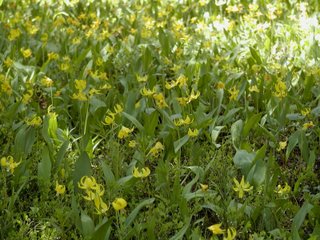
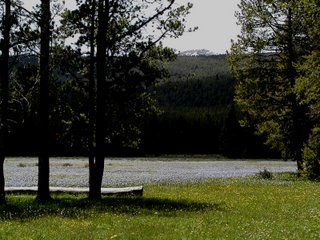
--filled with delicious smells. It was in summer that we first realized that "mountain-fresh scent" is a REAL smell, and not made up.
Summer in Montana. Ahhhhh.
Summer in Montana is:
--our payment for living through months of snow and below-zero temperatures.
--green, green, green. Flowers are blooming everywhere. We have fields of wildflowers up in the mountains that look like this:

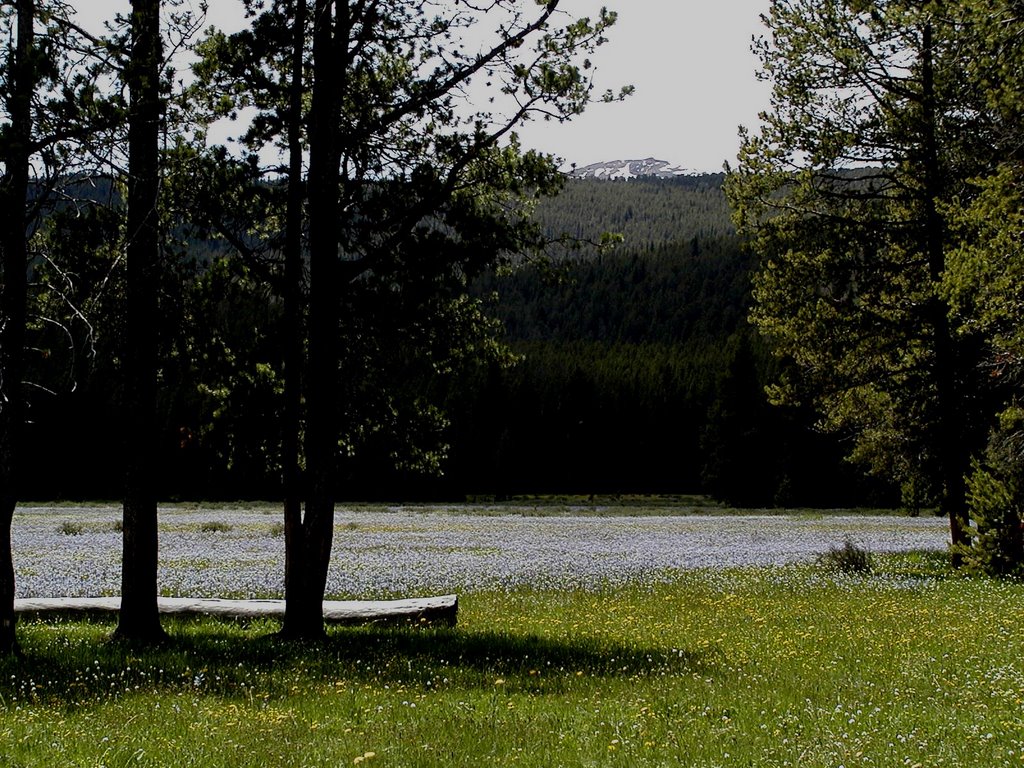
--filled with delicious smells. It was in summer that we first realized that "mountain-fresh scent" is a REAL smell, and not made up.
--the perfect temperature. High of 82 today, with a light breeze. Tons of sun.
--adventurous. Because we have such a short good-weather period, everyone runs out and does things every weekend. Day trips to waterslides, camping in the forest, barbecues by the river, fishing, you name it.
--in my town, firework season. Firework stands open 10 days before the 4th and stay open for a week after. During that period nearly everyone in town buys fireworks; many set them off EVERY NIGHT. These aren't your garden-variety sparklers, either. Here you can buy professional-style rockets, bursts, everything, for your home. The 3rd of July (our fireworks night) is an amazing experience.
--a little harder to write in than winter. See "adventurous" above and "the perfect temperature". There is definitely a pull to go for a walk during lunch instead of sitting at my desk with the door closed, looking out only my tiny little window. I'll admit I've been going out maybe one more day a week than usual. But then as I'm "between books" while I do the synopses and queries, I'm cutting myself a little slack too...
What is summer like in your part of the world?
Medieval Word of the Day: lainer: A lace, strap, thong, lash.
Friday, June 23, 2006
Question for You!
I'm afraid I'm feeling lazy today, so I'm going to do two easy bloggy things: a question for y'all, and a snippet.
But wait, first I'm going to go get a donut.
There, back with donut in hand. Lazy AND unhealthy...but happy. Mmmmmmmmmm.
Question first. I'm interested in finding out how many of y'all read (or did read) historical fiction...and what you liked. This is both occupational research and a little scrounging for more to add to the (already toppling, am I insane?) TBR pile. So please, even those of you who don't normally post comments, post with 3 historical fiction titles you really enjoyed. Doesn't matter how long ago you read them, either.
Hmmm, and now a snippet. It's getting harder to find something small that I haven't posted before, that's not a spoiler. I'm at least pretty sure I haven't posted this one here:
From The Murderess's Tale, Copyright Susan Adrian, 2006
But wait, first I'm going to go get a donut.
There, back with donut in hand. Lazy AND unhealthy...but happy. Mmmmmmmmmm.
Question first. I'm interested in finding out how many of y'all read (or did read) historical fiction...and what you liked. This is both occupational research and a little scrounging for more to add to the (already toppling, am I insane?) TBR pile. So please, even those of you who don't normally post comments, post with 3 historical fiction titles you really enjoyed. Doesn't matter how long ago you read them, either.
Hmmm, and now a snippet. It's getting harder to find something small that I haven't posted before, that's not a spoiler. I'm at least pretty sure I haven't posted this one here:
From The Murderess's Tale, Copyright Susan Adrian, 2006
I was dreaming of dragons. A golden dragon, with red eyes and breath of deadly fire, was chasing me through the countryside, laying waste to all we passed. I ran through a hollow, gasping for breath, searching for a place to hide. But he could see everywhere, everything. I was trapped.
I bolted upright, my hands clenching the silken sheets. It was night; the crackling fire was the only light, except for the cold silver of stars I could just glimpse through the window slits.
He had not come.
I was still alone, still safe. I wrapped the coverlet tighter around me. Still safe, for now.
I rubbed my eyes, wondering what had woken me. It seemed there had been a noise…it came again. Heavy footsteps on the floor above. A bang. Shouts. What was passing up there?
Well, if it kept the Duke from my chamber I was glad of it, whatever it might be. I slipped from the bed, pulled a shawl over my shift, and padded to the little fire. The room was cool, the white stones chill against my bare feet. I knelt next to the fire, breathing in the fragrant wood-smoke and stretching my hands out to the flames.
Fire. It was always the same, no matter my own fortunes. In Eva's kitchen, St. Mary's abbey, Godwina's house, here…fire was ever-present, giving warmth, cooking food. It mattered not to the fire if I was child or woman, captive or wife. I wondered suddenly if God was the same. Constant, unchanging. But was He uncaring too? Or did He really watch over us, care for us, if we lived well? Was Juliana right, that God had already abandoned us? Even the question was heresy. I could add heresy to my list of crimes.
Thursday, June 22, 2006
More Blogginess
Thanks for the feedback yesterday! Next step is to finish polishing these and then try the 1-pager. With actual plot and resolution.
I was trying to explain to someone the other day why I like reading blogs. This person was very dismissive of blogs: "They're like graffiti on the bathroom wall," he said. "Why would you want to read someone else's ramblings?"
Why indeed? Well, I've discussed this some before. (Blog Freak) It gives me a sense of connection to others like myself. But other than that it gives me information about writing and the industry that I would otherwise have to try to find in some print form. I can learn about the newest, freshest topics in the industry and how people are reacting to them real-time. I can get a sense of how other writers work, and how they handle the challenges we all face.
And besides, at least on writers' blogs (and agents and editors too), entries are hardly EVER ramblings. They're often well-thought-out, well-crafted, and fun to read.
Oh yeah, fun. That's the real reason. They're FUN to read. (And occasionally I get great recipes.)
Medieval Word of the Day: par charite: By or for Christian love, out of charity. Chiefly in adjurations.
I was trying to explain to someone the other day why I like reading blogs. This person was very dismissive of blogs: "They're like graffiti on the bathroom wall," he said. "Why would you want to read someone else's ramblings?"
Why indeed? Well, I've discussed this some before. (Blog Freak) It gives me a sense of connection to others like myself. But other than that it gives me information about writing and the industry that I would otherwise have to try to find in some print form. I can learn about the newest, freshest topics in the industry and how people are reacting to them real-time. I can get a sense of how other writers work, and how they handle the challenges we all face.
And besides, at least on writers' blogs (and agents and editors too), entries are hardly EVER ramblings. They're often well-thought-out, well-crafted, and fun to read.
Oh yeah, fun. That's the real reason. They're FUN to read. (And occasionally I get great recipes.)
Medieval Word of the Day: par charite: By or for Christian love, out of charity. Chiefly in adjurations.
Wednesday, June 21, 2006
Synopsis Project: #1 and #2
Okay, I've done some work on these--many of you will note that #2 is familiar. It's been a successful blurb so far, so I just reworked it a little.
These aren't true synopses so much as blurbs, but I think that's okay at the sentence/paragraph level. The whole shebang will be laid out in the 1-pager and above.
So what do you think? Feedback, please!
These aren't true synopses so much as blurbs, but I think that's okay at the sentence/paragraph level. The whole shebang will be laid out in the 1-pager and above.
So what do you think? Feedback, please!
The Murderess's Tale, by Susan Adrian
One Sentence
The Dread Pirate Synopsis
I was too busy yesterday to post here--which I hate, but sometimes it happens. Part of the busy-ness was secret spy stuff that I cannot yet reveal. I'll let y'all know how it develops though, if I can!
For the time being I am working rather loosely on my synopses while my readers are doing their thing.
Diana Gabaldon always says she doesn't understand why synopses are so hard for people--"just pretend you're telling the story to a friend." {sigh} It is harder than that. For me it's two things: the POV (third person present) is foreign, and the telling-not-showing is awkward. I keep wanting to put bits of the novel in there as examples, and running over space. Result: I have an awkward, kinda icky 4-page synopsis that does indeed tell the whole plot.
My task now is to write several synopses, in this order (thank you Dee-Ann for the strategy):
1-sentence synopsis
1-paragraph synopsis
1-page synopsis (which most of the agents seem to want)
2-page synopsis (a few want this)
4- to 5-page synopsis, for the rest
The hope here is that by the time I get to the 2-page synopsis I'll feel insanely free after trying to work in 1 paragraph and 1 page. We shall see.
Some of you may expect to be testers. :)
Medieval Word of the Day: keek (Scots and North): To peep; to look privily, as through a narrow aperture, or round a corner; to glance, gaze.
For the time being I am working rather loosely on my synopses while my readers are doing their thing.
Diana Gabaldon always says she doesn't understand why synopses are so hard for people--"just pretend you're telling the story to a friend." {sigh} It is harder than that. For me it's two things: the POV (third person present) is foreign, and the telling-not-showing is awkward. I keep wanting to put bits of the novel in there as examples, and running over space. Result: I have an awkward, kinda icky 4-page synopsis that does indeed tell the whole plot.
My task now is to write several synopses, in this order (thank you Dee-Ann for the strategy):
1-sentence synopsis
1-paragraph synopsis
1-page synopsis (which most of the agents seem to want)
2-page synopsis (a few want this)
4- to 5-page synopsis, for the rest
The hope here is that by the time I get to the 2-page synopsis I'll feel insanely free after trying to work in 1 paragraph and 1 page. We shall see.
Some of you may expect to be testers. :)
Medieval Word of the Day: keek (Scots and North): To peep; to look privily, as through a narrow aperture, or round a corner; to glance, gaze.
Monday, June 19, 2006
Not just the facts
Finally back, and the last trip was excellent, a lovely, lovely restful time. I haven't had a chance to devour a book like that in ages. (I'm reading Sara Donati's Into the Wilderness, and I can't believe I didn't read it years ago. This book is good. More when I've finished it.)
So while I was gone I asked about research, and the balance between research and imagination. For historical fiction, you have to decide somewhat early on how deep you're going to go into known facts, and how much you're going to be willing to make up.
I know more than one writer who has, IMO, gone too far over into the research realm. You've seen them too, on writer's boards: the ones who have been writing the same book for 10 years, and still aren't finished, who post questions like "How, exactly, would someone in 18th century England peel an onion? Is it the same way we would, or would there be a special tool? If there was a special tool, I'd like to track one down and get it, so I can feel it in my hands and understand how it was REALLY done..."
Hokay. When I read questions like that I have a very strong urge to post back and say "Make. It. UP. Move on to what your character is thinking and talking about while she's peeling the damn onion! What is she worrying over? What did she see that made her slip and cut her thumb with the knife?"
We're not writing treatises here, folks, or theses. We're trying to tell a STORY.
But then again you can't just make everything up, or you'll completely pull readers out of the story. You need to:
--do your basic research
--do more detailed research on things that matter to the story
--avoid anachronisms at all costs
--capture the flavor of the time, and add some special details that make the reader feel the differences (you will run across these in general and detailed research reading)
--find some good experts to read different parts over, to make sure you didn't make any huge gaffes
And (I hope) that's enough. It's all a balance. In those few moments when I've imagined my audience as the professional medieval scholar, I've scared myself silly, and I can't afford to do that.
On point #2, I absolutely adore interlibrary loan. I just a few minutes ago picked up The Premonstratensian Order in Late Medieval England by Joseph Gribben from my on-campus library, kindly loaned from the University of South Alabama. Isn't that the coolest?
Medieval Word of the Day: ribibe: An opprobrious or abusive term for an old woman.
So while I was gone I asked about research, and the balance between research and imagination. For historical fiction, you have to decide somewhat early on how deep you're going to go into known facts, and how much you're going to be willing to make up.
I know more than one writer who has, IMO, gone too far over into the research realm. You've seen them too, on writer's boards: the ones who have been writing the same book for 10 years, and still aren't finished, who post questions like "How, exactly, would someone in 18th century England peel an onion? Is it the same way we would, or would there be a special tool? If there was a special tool, I'd like to track one down and get it, so I can feel it in my hands and understand how it was REALLY done..."
Hokay. When I read questions like that I have a very strong urge to post back and say "Make. It. UP. Move on to what your character is thinking and talking about while she's peeling the damn onion! What is she worrying over? What did she see that made her slip and cut her thumb with the knife?"
We're not writing treatises here, folks, or theses. We're trying to tell a STORY.
But then again you can't just make everything up, or you'll completely pull readers out of the story. You need to:
--do your basic research
--do more detailed research on things that matter to the story
--avoid anachronisms at all costs
--capture the flavor of the time, and add some special details that make the reader feel the differences (you will run across these in general and detailed research reading)
--find some good experts to read different parts over, to make sure you didn't make any huge gaffes
And (I hope) that's enough. It's all a balance. In those few moments when I've imagined my audience as the professional medieval scholar, I've scared myself silly, and I can't afford to do that.
On point #2, I absolutely adore interlibrary loan. I just a few minutes ago picked up The Premonstratensian Order in Late Medieval England by Joseph Gribben from my on-campus library, kindly loaned from the University of South Alabama. Isn't that the coolest?
Medieval Word of the Day: ribibe: An opprobrious or abusive term for an old woman.
Thursday, June 15, 2006
Here I am...now I'm gone again
Sorry for the long absence! I was physically gone, of course, except for yesterday--only mentally gone yesterday--and will be physically gone again tomorrow. Then (praise somebody) I will be back on regular routine on Monday. I looove trips, but after a while I crave that routine. I want to just sit at my desk, do work, write, and not have to think about planning outfits or outings or pit stops.
That said, this weekend should be fun! (I am nothing if not contradictory. Aren't we all, really?)
TMT is out to...counting on fingers like all good English majors...5 readers (okay, one has already finished and one is cool Mr. Archaeologist, who is only reading 5 chapters). Other than that I went back over my agent list, and narrowed the first round down to my top candidates. So depending on what the readers say, after changes are made I just (just) need to revise my synopsis and cover letter and send that puppy out. Depending on what the readers say (that's a sly lil' phrase, isn't it?).
Work is freakin' busy this morning. My dad would say that I'm running around like a chicken with its head cut off. Of course I would not say that, but I can quote it. :P
Starting Monday we should be back to our regular blog schedule. Until then, talk amongst yourselves. Topic: In historical fiction, there is a continuum between accuracy and story. Do you stick to straight historical facts, embellish here and there for story, or make most of it up? Where do you fall? Discuss.
Medieval Word of the Day: feastly: Festive, fond of feasting, jolly.
That said, this weekend should be fun! (I am nothing if not contradictory. Aren't we all, really?)
TMT is out to...counting on fingers like all good English majors...5 readers (okay, one has already finished and one is cool Mr. Archaeologist, who is only reading 5 chapters). Other than that I went back over my agent list, and narrowed the first round down to my top candidates. So depending on what the readers say, after changes are made I just (just) need to revise my synopsis and cover letter and send that puppy out. Depending on what the readers say (that's a sly lil' phrase, isn't it?).
Work is freakin' busy this morning. My dad would say that I'm running around like a chicken with its head cut off. Of course I would not say that, but I can quote it. :P
Starting Monday we should be back to our regular blog schedule. Until then, talk amongst yourselves. Topic: In historical fiction, there is a continuum between accuracy and story. Do you stick to straight historical facts, embellish here and there for story, or make most of it up? Where do you fall? Discuss.
Medieval Word of the Day: feastly: Festive, fond of feasting, jolly.
Friday, June 09, 2006
DONE!
I finished the TMT revision yesterday! I made my archaeologist-inspired changes, wrapped it up, put a bow on it, and sent it out to my readers for a final read.
Whew.
The odd thing is that--as when I finished the final "first" draft--there was no elation, or even sense of accomplishment. Just letdown and a queasy sort of panic.
On analyzing it, I think the panic is just normal fear of change/unknown. As long as a writer is fiddling, editing, it's safe. The WIP is not yet done, anything can still be "fixed", so it can't really be judged. And you're on known territory, in your own files. Once you write it off as done you let other people into your work, into your world. You're admitting "I thought this was good, my best." And then you have to send it out to the people who really know.
Anyway, I am ready. We'll see what my readers say, but I plan to work on the synopsis today, then when I get back from my trips, the week of June 19, I'll start sending it out to my hand-picked agents. Time to move on.
Did I say trips? Yep, I'm leaving again tonight. This time I'll be in Billings to work a convention booth; not back until Wednesday. Then I'll be here Wednesday and Thursday before I take off again for 3 days. Craziness I'm not sure I'm ready for--but hey, the book is done! Don't have to worry about that while I'm in another hotel!
Medieval Word of the Day: demerlayk: Magic, practice of occult art, jugglery.
Whew.
The odd thing is that--as when I finished the final "first" draft--there was no elation, or even sense of accomplishment. Just letdown and a queasy sort of panic.
On analyzing it, I think the panic is just normal fear of change/unknown. As long as a writer is fiddling, editing, it's safe. The WIP is not yet done, anything can still be "fixed", so it can't really be judged. And you're on known territory, in your own files. Once you write it off as done you let other people into your work, into your world. You're admitting "I thought this was good, my best." And then you have to send it out to the people who really know.
Anyway, I am ready. We'll see what my readers say, but I plan to work on the synopsis today, then when I get back from my trips, the week of June 19, I'll start sending it out to my hand-picked agents. Time to move on.
Did I say trips? Yep, I'm leaving again tonight. This time I'll be in Billings to work a convention booth; not back until Wednesday. Then I'll be here Wednesday and Thursday before I take off again for 3 days. Craziness I'm not sure I'm ready for--but hey, the book is done! Don't have to worry about that while I'm in another hotel!
Medieval Word of the Day: demerlayk: Magic, practice of occult art, jugglery.
Thursday, June 08, 2006
Confession Time
ANNOUNCER (in a hearty voice): Welcome, folks! It's embarrassing fangirl confession time. That's right, the chance for you to hear the most horrifying confessions and laugh at them! Our participant today is Susan Adrian. Susan, come on up to the mic.
ME (with a shy wave): Hello.
ANNOUNCER: Susan, I understand that you have a particularly embarrassing confession today.
ME (quietly): Yes.
ANNOUNCER: Well, let's not keep those folks at home waiting. Tell us, Susan, what were you listening to today? All morning, in fact?
ME: mumble mumble mumble.
ANNOUNCER: What was that? I don't think you were speaking into the mic.
ME (whispering): Phantom of the Opera.
ANNOUNCER (bellows): PHANTOM OF THE OPERA! Ha ha ha! That's right. You were listening to it at work, weren't you?
ME: Um. Yes. With headphones.
ANNOUNCER: With headphones, so no one would know what it was! You are aware that Phantom is by Andrew Lloyd Webber, right? And many consider it trashy? Pop culture? Emotionally manipulative, with all those dramatic organ crashes?
ME (defensively): It was the original London cast recording.
ANNOUNCER (sarcastic): Oh, the original London cast recording. Which you bought. But did you not also buy the movie soundtrack? Did you? For purposes of comparison only, right?
ME: (no response)
ANNOUNCER: But here is the critical, most embarrassing question: while listening on your headphones this morning, did you SING ALONG? Did you in fact sing every word of "Notes" like the complete nerdy fangirl that you are?
__________________________
So goes the internal critic in my head. But I love PTO, dammit. Something about the whole tortured, maltreated genius/gorgeous hunky savior/confused young girl triangle speaks to me. I still get shivers when the Phantom laughs. But I do wish I could combine the Phantom of the original (Michael Crawford, whom I saw in one of his last performances, TG) with the Christine of the movie (Emmy Rossum). Now that would be perfect. {sigh}
Medieval Word of the Day: culpon: A piece cut off, a cutting; a portion, strip, slice, bit, shred.
ME (with a shy wave): Hello.
ANNOUNCER: Susan, I understand that you have a particularly embarrassing confession today.
ME (quietly): Yes.
ANNOUNCER: Well, let's not keep those folks at home waiting. Tell us, Susan, what were you listening to today? All morning, in fact?
ME: mumble mumble mumble.
ANNOUNCER: What was that? I don't think you were speaking into the mic.
ME (whispering): Phantom of the Opera.
ANNOUNCER (bellows): PHANTOM OF THE OPERA! Ha ha ha! That's right. You were listening to it at work, weren't you?
ME: Um. Yes. With headphones.
ANNOUNCER: With headphones, so no one would know what it was! You are aware that Phantom is by Andrew Lloyd Webber, right? And many consider it trashy? Pop culture? Emotionally manipulative, with all those dramatic organ crashes?
ME (defensively): It was the original London cast recording.
ANNOUNCER (sarcastic): Oh, the original London cast recording. Which you bought. But did you not also buy the movie soundtrack? Did you? For purposes of comparison only, right?
ME: (no response)
ANNOUNCER: But here is the critical, most embarrassing question: while listening on your headphones this morning, did you SING ALONG? Did you in fact sing every word of "Notes" like the complete nerdy fangirl that you are?
__________________________
So goes the internal critic in my head. But I love PTO, dammit. Something about the whole tortured, maltreated genius/gorgeous hunky savior/confused young girl triangle speaks to me. I still get shivers when the Phantom laughs. But I do wish I could combine the Phantom of the original (Michael Crawford, whom I saw in one of his last performances, TG) with the Christine of the movie (Emmy Rossum). Now that would be perfect. {sigh}
Medieval Word of the Day: culpon: A piece cut off, a cutting; a portion, strip, slice, bit, shred.
Wednesday, June 07, 2006
Archaeology is my friend
So I mentioned my new archaeologist contact in passing, but I don't think I ever explained. Several critical scenes in TMT take place in Beauchief Abbey, a small, now-ruined Premonstratensian abbey near Sheffield. When I first started writing about it I took lots of notes and stuffed them into a file, but there wasn't much info available. I spoke with my Premonstratensian historian about the order and its rituals, and what the abbey MIGHT have looked like--and he gave me a model floor plan of a "standard" abbey (Shap Abbey). I kinda took off from there with imagination.
While reviewing the final draft, though, I checked my notes again and found a "possible contact" name I'd never followed up on, an archaeologist at the University of Sheffield who was/is the lead of an archaeological project to excavate Beauchief. I figured I might as well contact him to check out some of my imagined details--it wouldn't hurt, right?
Wow. We made initial contact last week, but I emailed him yesterday with specific questions--and got back 17 emails with photos, captions, explanations, and maps. I am stunned with information, and absolutely thrilled. (The only niggling question is why didn't I do this before? But I easily wrestle those thoughts to the ground.)
There are many cool things about this, but here are two of the best:
1. He says the best model for the floor plan is Shap Abbey, which I was already using. Waa-haa! I have most everything pretty close; I only need to tweak a few things here and there.
2. I asked if he'd mind reading the chapters in question after I make my initial tweaks, just to make sure I didn't miss anything. His response? He'd not only be pleased to, but he said he'd take my chapters up to the abbey site and read them there, under the shadow of the tower, to "get in the proper mood." Oooooh. I love this.
Moral: Follow up on those possible connections. Particularly for historical fiction writers, those academic and real-life contacts can be invaluable. (and fun!)
Medieval Word of the Day: Lucina: In Roman mythology, the goddess who presided over childbirth, sometimes identified with Juno or with Diana; hence, a midwife.
While reviewing the final draft, though, I checked my notes again and found a "possible contact" name I'd never followed up on, an archaeologist at the University of Sheffield who was/is the lead of an archaeological project to excavate Beauchief. I figured I might as well contact him to check out some of my imagined details--it wouldn't hurt, right?
Wow. We made initial contact last week, but I emailed him yesterday with specific questions--and got back 17 emails with photos, captions, explanations, and maps. I am stunned with information, and absolutely thrilled. (The only niggling question is why didn't I do this before? But I easily wrestle those thoughts to the ground.)
There are many cool things about this, but here are two of the best:
1. He says the best model for the floor plan is Shap Abbey, which I was already using. Waa-haa! I have most everything pretty close; I only need to tweak a few things here and there.
2. I asked if he'd mind reading the chapters in question after I make my initial tweaks, just to make sure I didn't miss anything. His response? He'd not only be pleased to, but he said he'd take my chapters up to the abbey site and read them there, under the shadow of the tower, to "get in the proper mood." Oooooh. I love this.
Moral: Follow up on those possible connections. Particularly for historical fiction writers, those academic and real-life contacts can be invaluable. (and fun!)
Medieval Word of the Day: Lucina: In Roman mythology, the goddess who presided over childbirth, sometimes identified with Juno or with Diana; hence, a midwife.
Tuesday, June 06, 2006
Woof!
Today I'm thinking about animals in fiction.
A long time ago we had a discussion on Books and Writers about dogs, and how every novel seemed to have a dog in it somewhere.
TMT has 2 dogs, look-alikes, which is slightly important for the plot. The second dog reminds the MC of the first, and home, thus allowing for reflection; he supplies a needed distraction to allow a conversation to take place; and he smooths over the introduction of a male MC. And at the end, the reappearance of Dog 1 emphasizes the complete circle.
The dogs also provide one of the usual "pet" effects: a softening of the MC, allowing her to show affection and care for an animal as a precursor of what she'll do for other people later. I think this is a fairly common reason to have an animal in a book, actually. With an animal, particularly a pet, you can show sides of your character that normally might be hidden. You can make them vulnerable, or human--or, with a different kind of "pet", even vicious and vengeful. You can make an extra connection to the reader.
Dog 2 came first in TMT, very very early on. In fact, Dog 2 was the first moment, in my early days of writing, when I did not control the plot. My MC was walking down a medieval street, off on her own (my) business, and suddenly there was a DOG! I had no idea at the time what had happened (Why is there a dog? I didn't plan for a dog!), but it was just the first instance of the characters taking over, for their own reasons. Usually much better than mine.
So let's try for some comments today. Is there a dog in your WIP? Or a cat? (A pet horse? An iguana?) If there is, what purpose does he/she serve?
Medieval Word of the Day: lykewake: The watch kept at night over a dead body.
A long time ago we had a discussion on Books and Writers about dogs, and how every novel seemed to have a dog in it somewhere.
TMT has 2 dogs, look-alikes, which is slightly important for the plot. The second dog reminds the MC of the first, and home, thus allowing for reflection; he supplies a needed distraction to allow a conversation to take place; and he smooths over the introduction of a male MC. And at the end, the reappearance of Dog 1 emphasizes the complete circle.
The dogs also provide one of the usual "pet" effects: a softening of the MC, allowing her to show affection and care for an animal as a precursor of what she'll do for other people later. I think this is a fairly common reason to have an animal in a book, actually. With an animal, particularly a pet, you can show sides of your character that normally might be hidden. You can make them vulnerable, or human--or, with a different kind of "pet", even vicious and vengeful. You can make an extra connection to the reader.
Dog 2 came first in TMT, very very early on. In fact, Dog 2 was the first moment, in my early days of writing, when I did not control the plot. My MC was walking down a medieval street, off on her own (my) business, and suddenly there was a DOG! I had no idea at the time what had happened (Why is there a dog? I didn't plan for a dog!), but it was just the first instance of the characters taking over, for their own reasons. Usually much better than mine.
So let's try for some comments today. Is there a dog in your WIP? Or a cat? (A pet horse? An iguana?) If there is, what purpose does he/she serve?
Medieval Word of the Day: lykewake: The watch kept at night over a dead body.
Monday, June 05, 2006
The Play and the Book
Whew. That was a long and busy weekend, what with the play performances and all. "Sarah, Plain and Tall" is wrapped now, and I'm glad--though I'm also very glad I did it. It was great fun for me, it stretched my long-disused acting muscles, and I think it was a good example for Child. She wrote a "play" this weekend that we're all supposed to practice tonight, and "open" tomorrow. Woo-hoo.
Anyhow, I am now back in the office, eating radishes (don't ask) and trying to catch up.
So I didn't get a chance to post this on the blog, but I actually did finish my page-by-page, line-by-line revision last week. SWEET! The next step is to go over the Beauchief Abbey scenes, compare them to the info my new archaeologist contact gave me, and then contact him again where I need more detail. I'm hoping to actually get photos or a supposed layout. Then I just have to read it one more time {sigh} to make sure it hangs together and then send it to my volunteer readers. THEN I can send the bloody thing out again.
I am so, so sick of it at this point. Argh. I want it to be done and to go away and have other people deal with it. I was at first a bit worried about this feeling, but my writer friends tell me it's a normal and healthy sign. Thank goodness it doesn't mean that it just sucks. :)
Medieval Word of the Day: lite (verb): intr. To expect, wait, delay.
(Huh. That one's changed a bit since, hasn't it?)
Friday, June 02, 2006
Fly by
Opening night went perfectly, yay us!
I'm afraid this is just an info post-and-run. I am at home today with Child, as she is off school. We just got back from her school program and potluck...picture 30 small children singing in Italian and Spanish and dancing with big sombreros on. It rocked.
Anyway, now she's taking a nap and I am seriously torn between doing the household chores that desperately need doing and taking a nap. Or having coffee. Hmmm. Laundry, kitchen, nap? Nap and then coffee? Laundry and then nap and then coffee?
You see my dilemma. And tomorrow is the weekend, so there won't be much until Monday. So have a lovely 3 days or so, and I will return, hopefully with something more pithy than laundry and naps.
Medieval Word of the Day: scurn: to shrink, flinch; take fright.
I'm afraid this is just an info post-and-run. I am at home today with Child, as she is off school. We just got back from her school program and potluck...picture 30 small children singing in Italian and Spanish and dancing with big sombreros on. It rocked.
Anyway, now she's taking a nap and I am seriously torn between doing the household chores that desperately need doing and taking a nap. Or having coffee. Hmmm. Laundry, kitchen, nap? Nap and then coffee? Laundry and then nap and then coffee?
You see my dilemma. And tomorrow is the weekend, so there won't be much until Monday. So have a lovely 3 days or so, and I will return, hopefully with something more pithy than laundry and naps.
Medieval Word of the Day: scurn: to shrink, flinch; take fright.
Thursday, June 01, 2006
Writers' brains
I realized yet again last night that writers' brains do not work like other people's.
It was our final "preview performance" of the play before opening night, and I was sitting in the green room in full 1900s farmwoman costume, reading "Common Women : Prostitution and Sexuality in Medieval England". (Strange choice for bringing to read at a kids' play, you say? Yes, I suppose so. But they're mostly teenagers, and it's not like I'm letting them READ it.)
But one of the older cast members sits next to me, and says "How's the research coming?" He'd asked about it before, so I'd mentioned my book and all.
"Good," I say cautiously. I don't like to be all pretentious and writer-y.
"Yeah?" he asks. "Did you find any good information?"
Hmm. I look at him, considering. He seems genuinely interested, not just polite. And he did ask a follow-up question.
"Yeah, I did!" I say, allowing some of my excitement to show. "I found a quote I can use! See here?" I flip back a few pages, to a place marked with a sticky note. "It's a real medieval insult recorded in a court case. 'Any man could meddle with her for a half-penny.' Isn't that cool? I can use that somewhere!"
I look up. He's staring at me, with an expression that clearly indicates that I'm somewhere on the outer edges of the lunatic fringe. "Yeeeesss," he says. His gaze flicks up over my head, then away to the other side of the room, clearly distancing himself from crazy medieval girl. "I suppose you could."
{sigh}
"But it's real," I mutter to myself under my breath. "I can use that somewhere."
It was exciting, to me. It always is when I find something new I can add in, or make a connection. But really, I don't know why I bother. They just don't understand.
Medieval Word of the Day: hotfoot: With eager or rapid pace; in hot haste; hastily.
It was our final "preview performance" of the play before opening night, and I was sitting in the green room in full 1900s farmwoman costume, reading "Common Women : Prostitution and Sexuality in Medieval England". (Strange choice for bringing to read at a kids' play, you say? Yes, I suppose so. But they're mostly teenagers, and it's not like I'm letting them READ it.)
But one of the older cast members sits next to me, and says "How's the research coming?" He'd asked about it before, so I'd mentioned my book and all.
"Good," I say cautiously. I don't like to be all pretentious and writer-y.
"Yeah?" he asks. "Did you find any good information?"
Hmm. I look at him, considering. He seems genuinely interested, not just polite. And he did ask a follow-up question.
"Yeah, I did!" I say, allowing some of my excitement to show. "I found a quote I can use! See here?" I flip back a few pages, to a place marked with a sticky note. "It's a real medieval insult recorded in a court case. 'Any man could meddle with her for a half-penny.' Isn't that cool? I can use that somewhere!"
I look up. He's staring at me, with an expression that clearly indicates that I'm somewhere on the outer edges of the lunatic fringe. "Yeeeesss," he says. His gaze flicks up over my head, then away to the other side of the room, clearly distancing himself from crazy medieval girl. "I suppose you could."
{sigh}
"But it's real," I mutter to myself under my breath. "I can use that somewhere."
It was exciting, to me. It always is when I find something new I can add in, or make a connection. But really, I don't know why I bother. They just don't understand.
Medieval Word of the Day: hotfoot: With eager or rapid pace; in hot haste; hastily.
Wednesday, May 31, 2006
First-time publishing advice
I just ran across an excellent (old) article on Backspace by Jenny Bent--a realistic take on the process of publishing for first-timers. Check it out!
What to Expect When You Get Published
What to Expect When You Get Published
When you can't write
Well, yesterday ended up being extremely sucky--but I kept my whining to my girlfriend group, and they propped me up again. (yes, they rock!) So all is at least back to a normal level today.
But with vacation, post-vacation, intense everyday play rehearsals, work, picking up parents at the airport, etc., I haven't been able to write anything since...geez, since Wednesday last. A full blooming week. I will squeeze some in today because I'm getting itchy. Plus I have a secret fear that if I stop for any longer than that, some dread thing will happen--I will lose momentum, or drive, or discipline--and I won't be able to pick up easily again. Or maybe the characters will get pissed off and desert me. Or I will somehow forget all that I have learned. {shrug} I think a week is about my limit.
So we all know that Life intervenes sometimes, despite our very best intentions. What do YOU do when you can't write due to circumstance? Do you feel lonely without the characters, as I do? Do you feel restless? Do you feel at odds, like there's something missing? How do you handle the itchy feeling?
And do you have the secret fear too? I bet most writers do, but I'm just guessing here.
Medieval Word of the Day: gegge: A term, apparently contemptuous, applied both to man and woman.
But with vacation, post-vacation, intense everyday play rehearsals, work, picking up parents at the airport, etc., I haven't been able to write anything since...geez, since Wednesday last. A full blooming week. I will squeeze some in today because I'm getting itchy. Plus I have a secret fear that if I stop for any longer than that, some dread thing will happen--I will lose momentum, or drive, or discipline--and I won't be able to pick up easily again. Or maybe the characters will get pissed off and desert me. Or I will somehow forget all that I have learned. {shrug} I think a week is about my limit.
So we all know that Life intervenes sometimes, despite our very best intentions. What do YOU do when you can't write due to circumstance? Do you feel lonely without the characters, as I do? Do you feel restless? Do you feel at odds, like there's something missing? How do you handle the itchy feeling?
And do you have the secret fear too? I bet most writers do, but I'm just guessing here.
Medieval Word of the Day: gegge: A term, apparently contemptuous, applied both to man and woman.
Tuesday, May 30, 2006
Back!
I am back!
As always when returning from vacation, there are mixed emotions. Vacations, while tons o' fun, are also a wee bit stressful for me. There's all that planning, packing, uncertainty, pressure to be doing things, time crunches...(yes, on vacation! Aren't I type A to the extreme?) So in that sense it's a relief when we're back home, and can drop into our normal, known routines, pick up with friends again, have a wide variety of clothes to choose from...
But then half a day in I miss being on vacation.
Anyway, San Diego was fabulous, and we did manage a very good mix of relaxation and excitement. Here are some of my favorite moments:
Medieval Word of the Day: unkithe: to disappear; vanish.
As always when returning from vacation, there are mixed emotions. Vacations, while tons o' fun, are also a wee bit stressful for me. There's all that planning, packing, uncertainty, pressure to be doing things, time crunches...(yes, on vacation! Aren't I type A to the extreme?) So in that sense it's a relief when we're back home, and can drop into our normal, known routines, pick up with friends again, have a wide variety of clothes to choose from...
But then half a day in I miss being on vacation.
Anyway, San Diego was fabulous, and we did manage a very good mix of relaxation and excitement. Here are some of my favorite moments:
- Taking Child to the beach on the first day (we almost always do this first). We poked around for shells, chased the seagulls, curled our bare toes in the sand and faced the surf together. There was a moment when her daddy was showing her a crab in one of the tidepools, and I just stood there, warm in the sun, staring at the ocean. Lovely.
- Going to a Padres baseball game in the new stadium! We had great seats and lots of bad-for-you munchies. And the Pads hit 3 homers, made fabulous defensive plays, and beat the Cardinals 7-1.
- Playing in the fabulous kid's area of the Science Center, which we got into for free since we are members of the Museum of the Rockies here. Sweeeet.
- Taking long naps in the hotel. What is it about those blackout curtains and big pillows that just tempt me into naps?
- Going shopping and buying lots of summery clothes and new sandals. And 4 (count 'em, 4) summer dresses for Child, who is ecstatic about this, and wearing one of them to preschool this morning.
- Discovering to our complete surprise that the Balboa Park international houses were having a celebration for Memorial Day, with all the yummy food from all over that we haven't had since we left. We had Argentinian empanadas, Norwegian open-faced sandwiches, Czech pastries, and Scottish cake. All while sitting on the grass in the sun.
- Being lovely and warm. (It snowed back home this weekend, which I am thrilled that we missed)
- The food! Mexican, Thai (mmmm), even burgers. Yessss.
Medieval Word of the Day: unkithe: to disappear; vanish.
Wednesday, May 24, 2006
Top 10 books you haven't heard of
Well, today is strange because it's my last day pre-vacation, so of course I'm running around like a chicken with its head cut off (as my dad would say) in prep. After this post, I won't be back near a computer until Tuesday, so I'll see you then!
Because of busy-ness, in lieu of a writing post today I'm going to post my list of 10 books that are excellent, excellent reads that you've probably never heard of. Philippa Gregory, Diana Gabaldon, even Mary Stewart you might have read, so I won't include those. Just the overlooked gems, as it were. Check them out if you're so inclined!
(in no particular order)
1. Seen by Moonlight, by Kathleen Eschenburg (civil war romance)
2. If I Never Get Back, by Daryl Brock (baseball time travel, male POV. fantastic book)
3. Suspicion, by Barbara Rogan (contemporary ghost story)
4. Doomsday Book, by Connie Willis (14th century time travel, but not your ordinary time travel)
5. The Dark Is Rising, by Susan Cooper (first book of a fantastic YA series; I must've read it 10 times at least, and still remember bits word for word)
6. She Goes to War, by Edith Pargeter (a phenomenal account of a woman's experiences in the military in WWII England; fiction, but very realistic)
7. An Acceptable Time, by Madeleine L'Engle (most people have read A Wrinkle in Time, but this one is less well known, and also an amazingly strong YA, with time travel)
8. The Canterbury Papers, by Judith Healey (strong medieval suspense)
9. Through a Glass Darkly, by Karleen Koen (true character-driven historical)
10. The Long Dark Tea Time of the Soul, by Douglas Adams (not a part of the Hitchhiker's Guide series, this book is Hilarious. I dare you to start reading it and then stop. Oh, and not laugh.)
Medieval Word of the Day: tumblester: A female tumbler or dancer; a dancing-girl.
Because of busy-ness, in lieu of a writing post today I'm going to post my list of 10 books that are excellent, excellent reads that you've probably never heard of. Philippa Gregory, Diana Gabaldon, even Mary Stewart you might have read, so I won't include those. Just the overlooked gems, as it were. Check them out if you're so inclined!
(in no particular order)
1. Seen by Moonlight, by Kathleen Eschenburg (civil war romance)
2. If I Never Get Back, by Daryl Brock (baseball time travel, male POV. fantastic book)
3. Suspicion, by Barbara Rogan (contemporary ghost story)
4. Doomsday Book, by Connie Willis (14th century time travel, but not your ordinary time travel)
5. The Dark Is Rising, by Susan Cooper (first book of a fantastic YA series; I must've read it 10 times at least, and still remember bits word for word)
6. She Goes to War, by Edith Pargeter (a phenomenal account of a woman's experiences in the military in WWII England; fiction, but very realistic)
7. An Acceptable Time, by Madeleine L'Engle (most people have read A Wrinkle in Time, but this one is less well known, and also an amazingly strong YA, with time travel)
8. The Canterbury Papers, by Judith Healey (strong medieval suspense)
9. Through a Glass Darkly, by Karleen Koen (true character-driven historical)
10. The Long Dark Tea Time of the Soul, by Douglas Adams (not a part of the Hitchhiker's Guide series, this book is Hilarious. I dare you to start reading it and then stop. Oh, and not laugh.)
Medieval Word of the Day: tumblester: A female tumbler or dancer; a dancing-girl.
Tuesday, May 23, 2006
Marketplace
You know, it's a really good thing that I'm not trying to write to a market, because I would be driving myself insane.
I'm in an odd place, just now. Because I'm revising I'm not yet sending out queries, but I'm not head-down writing all new stuff either. The book is done, I'm just tweaking it to make it better--and at the same time, researching my publishing possibilities. I have one foot on each side of the great divide, writing and marketing.
So if I was susceptible to rumors about "the market", this is the point where I could seriously mess up my book. (Sexy sells? Quick, put in more sex! First person doesn't sell? Quick, change to third!) Ack. Of course there's nothing I can do about the fact that it's a historical. I do listen with interest when folks talk about the historical trends (down, up, dead, just on the verge, coming back), but that part is not going to change.
Yet I am altering the book slightly to integrate some feedback from agents. Heck, when one of THE primary movers and shakers in historical publishing tells me the book would be stronger with a bigger presence from real historical characters? If I can do that, and only make the book deeper, you can bet I will.
It's a fine line, isn't it? I guess it all comes down to what I've talked about before, whether the changes resonate with me or not as being true to the book. Changing to third would kill it. Changing the MC would kill it. Adding in a scene with the king present? Just bonus.
I still haven't got Chaucer in there, though. He'll just have to wait until the next book.
Medieval Word of the Day: argol: The tartar deposited from wines completely fermented, and adhering to the sides of the casks as a hard crust; crude bitartrate of potassium, which, when purified, becomes cream of tartar.
I'm in an odd place, just now. Because I'm revising I'm not yet sending out queries, but I'm not head-down writing all new stuff either. The book is done, I'm just tweaking it to make it better--and at the same time, researching my publishing possibilities. I have one foot on each side of the great divide, writing and marketing.
So if I was susceptible to rumors about "the market", this is the point where I could seriously mess up my book. (Sexy sells? Quick, put in more sex! First person doesn't sell? Quick, change to third!) Ack. Of course there's nothing I can do about the fact that it's a historical. I do listen with interest when folks talk about the historical trends (down, up, dead, just on the verge, coming back), but that part is not going to change.
Yet I am altering the book slightly to integrate some feedback from agents. Heck, when one of THE primary movers and shakers in historical publishing tells me the book would be stronger with a bigger presence from real historical characters? If I can do that, and only make the book deeper, you can bet I will.
It's a fine line, isn't it? I guess it all comes down to what I've talked about before, whether the changes resonate with me or not as being true to the book. Changing to third would kill it. Changing the MC would kill it. Adding in a scene with the king present? Just bonus.
I still haven't got Chaucer in there, though. He'll just have to wait until the next book.
Medieval Word of the Day: argol: The tartar deposited from wines completely fermented, and adhering to the sides of the casks as a hard crust; crude bitartrate of potassium, which, when purified, becomes cream of tartar.
Monday, May 22, 2006
Writing Update
I am now 85% done with editing TMT! Unfortunately the next scene needs a lot of sprucing...it's currently (ick) sappy. Remind me never to write a full-on romance; my romancy scenes are definitely the weakest.
The good news is I know this, and can make it better.
The good news is I know this, and can make it better.
Rollercoaster
Ack. There was a complete kerfuffle at work today. People getting pissed off at other people, people throwing money at other people in a huff (!), people sending out emails to ALL about what other people should not be doing anymore...{sigh} I would try to stay out of it, but sadly I'm the boss, and they all keep coming to me. {head. on. desk.}
Anyway, I hope it's over now, and we can all get back to some sort of non-junior-high behavior. One can only hope. In any case I am in the 3 days between weekend and vacation (San Diego! Huzzah!), so I just have to hang on for a little longer.
Now, to writing talk.
Here's a question that comes up, over and over, on writing boards and the like: "What do you do when you're stuck? How do you get past writer's block?"
First, I hate the term "writer's block". It bugs me. I guess because in my experience people who say they have "writer's block" tend to use it as a crutch, as a valid reason not to write. "Oh, I'd be writing now, but I have this horrible writer's block, so I'll have to wait until that's gone." Or worse, "The muse is not speaking to me right now."
Thus I will say that I've never had "writer's block". What I have experienced--and no doubt ALL of you other writers have too--are the difficult, dark times of writing. The struggles. The times when you sit down and write, and absolutely everything sounds like crap, like you've forgotten how to put a sentence together so that it makes some sort of sense. Or worse: the plot is a mystery to you, the characters are dull and lifeless, you can't see why on earth you ever thought you could write a decent book that anyone would want to read. The Doldrums.
I suspect the doldrums are a normal part of the writing process, nasty as they can be. From the little time I've been doing this fiction thing (roughly 6 years), I've noticed that there are cycles. Sometimes the writing is up, up, up, fast and furious, wonderful inspired stuff; sometimes it's just work, one word in front of the other; and sometimes there are the doldrums. But it's all normal, and we all experience these cycles.
So how do you get past the doldrums? Some writers find success in going to another WIP, in varying their mental landscape. People who actually make their living writing probably have to do multiple projects to make it a go. Failing that, my answer is the only answer, I think: keep writing. Don't stop because of doldrums. Don't give up. (Don't throw out all the "crap" you write while in them, either; it's probably not as bad as you think, and some can be saved.) Keep Writing Regularly. If you work at it, it will get better. Things will swing around again, and lo and behold you're in a fast and furious, genius phase.
Oh, and make sure you get support from your writer buddies when you're in a low phase. If you pick the right ones, they're really, really good at telling you you're full of it and you don't suck as bad as you think.
Right, Ladies? :)
(And thank God I'm not in the doldrums right now. Halfway between fast and furious and work, I think.)
Medieval Word of the Day: sleme: weariness.
Anyway, I hope it's over now, and we can all get back to some sort of non-junior-high behavior. One can only hope. In any case I am in the 3 days between weekend and vacation (San Diego! Huzzah!), so I just have to hang on for a little longer.
Now, to writing talk.
Here's a question that comes up, over and over, on writing boards and the like: "What do you do when you're stuck? How do you get past writer's block?"
First, I hate the term "writer's block". It bugs me. I guess because in my experience people who say they have "writer's block" tend to use it as a crutch, as a valid reason not to write. "Oh, I'd be writing now, but I have this horrible writer's block, so I'll have to wait until that's gone." Or worse, "The muse is not speaking to me right now."
Thus I will say that I've never had "writer's block". What I have experienced--and no doubt ALL of you other writers have too--are the difficult, dark times of writing. The struggles. The times when you sit down and write, and absolutely everything sounds like crap, like you've forgotten how to put a sentence together so that it makes some sort of sense. Or worse: the plot is a mystery to you, the characters are dull and lifeless, you can't see why on earth you ever thought you could write a decent book that anyone would want to read. The Doldrums.
I suspect the doldrums are a normal part of the writing process, nasty as they can be. From the little time I've been doing this fiction thing (roughly 6 years), I've noticed that there are cycles. Sometimes the writing is up, up, up, fast and furious, wonderful inspired stuff; sometimes it's just work, one word in front of the other; and sometimes there are the doldrums. But it's all normal, and we all experience these cycles.
So how do you get past the doldrums? Some writers find success in going to another WIP, in varying their mental landscape. People who actually make their living writing probably have to do multiple projects to make it a go. Failing that, my answer is the only answer, I think: keep writing. Don't stop because of doldrums. Don't give up. (Don't throw out all the "crap" you write while in them, either; it's probably not as bad as you think, and some can be saved.) Keep Writing Regularly. If you work at it, it will get better. Things will swing around again, and lo and behold you're in a fast and furious, genius phase.
Oh, and make sure you get support from your writer buddies when you're in a low phase. If you pick the right ones, they're really, really good at telling you you're full of it and you don't suck as bad as you think.
Right, Ladies? :)
(And thank God I'm not in the doldrums right now. Halfway between fast and furious and work, I think.)
Medieval Word of the Day: sleme: weariness.
Friday, May 19, 2006
Stronger than an Angry Mom
I'm almost to the super action hero bit of TMT, editing-wise. I'll bet you didn't know a 16-year-old medieval girl could be a super action hero, huh? If you do enough Bad Stuff to a character...
I guess she's not a super action hero exactly. But she is...umm...forceful.
From The Murderess's Tale, Copyright 2006 by Susan Adrian, All Rights Reserved
I must admit these are some of my very favorite scenes. There's only so much you can take, even if you're a normal girl, before losing it. And I don't recommend messing with a woman's kid, unless you want to see the vindictive mama-bear come out.
On another note, I realized yesterday that I was severely short on description of the church in these abbey scenes, so I took a bold step and e-mailed an archaeology professor at Sheffield University who has worked on the actual site, to see what he knows. What do I risk? Having to re-write the whole section, potentially, to fit "reality". But if I can make it more real from known information, I certainly will. And this is the perfect time in the process to do that. (Okay, it probably would've been better in the First draft, but then I just wanted to get this part of the plot done!)
Not much else of interest at the moment. Readying for the weekend, and vacation next week. A blasted squirrel apparently bit through our transformer this morning and knocked out power for a while, but obviously we're back up...
Medieval Word of the Day: Chichevache: The proper name of a fabulous monster said to feed only on patient wives, and hence, from the scarcity of the diet, to be always lean and hungry. Cf. BYCORNE.
I guess she's not a super action hero exactly. But she is...umm...forceful.
From The Murderess's Tale, Copyright 2006 by Susan Adrian, All Rights Reserved
Robert held out his hands as if to stop me. "What sin is this?" he screeched.
I did not stop. I pushed past his hands and dug the point of my knife into the soft flesh of his neck. He flattened against the wall, his eyes bulging.
"Who did this?" I hissed. "Where is the child?"
He swallowed, his Adam's apple sliding past the knife. "What mean you?"
I shoved the knife further, drawing blood. He gasped. Out of the corner of my eye I saw a tonsured head peek through the arch, then pull back quickly. No one came to help the Prior.
I must admit these are some of my very favorite scenes. There's only so much you can take, even if you're a normal girl, before losing it. And I don't recommend messing with a woman's kid, unless you want to see the vindictive mama-bear come out.
On another note, I realized yesterday that I was severely short on description of the church in these abbey scenes, so I took a bold step and e-mailed an archaeology professor at Sheffield University who has worked on the actual site, to see what he knows. What do I risk? Having to re-write the whole section, potentially, to fit "reality". But if I can make it more real from known information, I certainly will. And this is the perfect time in the process to do that. (Okay, it probably would've been better in the First draft, but then I just wanted to get this part of the plot done!)
Not much else of interest at the moment. Readying for the weekend, and vacation next week. A blasted squirrel apparently bit through our transformer this morning and knocked out power for a while, but obviously we're back up...
Medieval Word of the Day: Chichevache: The proper name of a fabulous monster said to feed only on patient wives, and hence, from the scarcity of the diet, to be always lean and hungry. Cf. BYCORNE.
(Man, I love these old tales.)
Thursday, May 18, 2006
Now and Then
We're having a heat wave here in Montana. It's been 85 degrees for the past few days.
Hey, don't laugh! For Montanans that IS a heat wave, especially in May. And oddly enough, early and lengthy heat is causing flooding concern--all our lovely snow pack is melting too fast, and pushing the river levels up. Good for trees and flowers and all, not so good for our water levels either now or in late summer...
Anyway, in my continuing series on blogs (heck, 3 days counts as a continuing series, right?), I want to touch on another purpose of blog reading: they connect me to my past, and also allow me a glimpse into the future.
First, the past. I love to read Bookseller Chick. She's smart and funny, and has interesting thoughts on the bookselling and publishing industry. But more, I've been there.
Before I was an editor, I was a bookseller. See, I graduated in 1992 with my newly minted English degree, all ready to take the world by storm...and discovered that in 1992, there weren't many jobs for engineering graduates, much less English majors. I couldn't find a blasted job to save my life. Grrr. So when a bookseller friend in San Diego said she could get me a clerk job...well, I went. At least I'd be around books, I had a roommate...it would work for a while.
And it did. Except I wasn't a clerk for long; after a few months I went to manager trainee, then manager. Eventually I switched bookstore chains, but all told I worked in the bookstore industry at varying levels for 3 years, and managed several stores. (And I met my husband there, so yay for those years!)
So when Bookseller Chick talks about shelving issues, or author visits, or Christmas craze, or searching for the mysterious blue book, I get it. I remember all that. One of her posts actually made me nostalgic for opening boxes; I used to love to hide in the back and open boxes every once in a while. Her blog makes me think of things, feel things, that have been put away for a long time. It's another type of connection.
Then, the future. Well, the hoped-for future. I love to read the blogs of those who are newly published, or newly agented. Their stories are fascinating to me, in a can't-tear-my-eyes-away kind of way. I need to know this stuff, so I can be one of those too! I was daydreaming about agents in the shower this morning, I kid you not. (Should I send to this one? No, that one? But what if they BOTH asked for the full at one time? Yeah, get to work on the revisions, woman, THEN we'll see...)
Medieval Word of the Day: feminie: Womankind; a ‘set’ of women, esp. the Amazons; also the country of the Amazons. (reminder: all my words and definitions come from the online OED).
Hey, don't laugh! For Montanans that IS a heat wave, especially in May. And oddly enough, early and lengthy heat is causing flooding concern--all our lovely snow pack is melting too fast, and pushing the river levels up. Good for trees and flowers and all, not so good for our water levels either now or in late summer...
Anyway, in my continuing series on blogs (heck, 3 days counts as a continuing series, right?), I want to touch on another purpose of blog reading: they connect me to my past, and also allow me a glimpse into the future.
First, the past. I love to read Bookseller Chick. She's smart and funny, and has interesting thoughts on the bookselling and publishing industry. But more, I've been there.
Before I was an editor, I was a bookseller. See, I graduated in 1992 with my newly minted English degree, all ready to take the world by storm...and discovered that in 1992, there weren't many jobs for engineering graduates, much less English majors. I couldn't find a blasted job to save my life. Grrr. So when a bookseller friend in San Diego said she could get me a clerk job...well, I went. At least I'd be around books, I had a roommate...it would work for a while.
And it did. Except I wasn't a clerk for long; after a few months I went to manager trainee, then manager. Eventually I switched bookstore chains, but all told I worked in the bookstore industry at varying levels for 3 years, and managed several stores. (And I met my husband there, so yay for those years!)
So when Bookseller Chick talks about shelving issues, or author visits, or Christmas craze, or searching for the mysterious blue book, I get it. I remember all that. One of her posts actually made me nostalgic for opening boxes; I used to love to hide in the back and open boxes every once in a while. Her blog makes me think of things, feel things, that have been put away for a long time. It's another type of connection.
Then, the future. Well, the hoped-for future. I love to read the blogs of those who are newly published, or newly agented. Their stories are fascinating to me, in a can't-tear-my-eyes-away kind of way. I need to know this stuff, so I can be one of those too! I was daydreaming about agents in the shower this morning, I kid you not. (Should I send to this one? No, that one? But what if they BOTH asked for the full at one time? Yeah, get to work on the revisions, woman, THEN we'll see...)
Medieval Word of the Day: feminie: Womankind; a ‘set’ of women, esp. the Amazons; also the country of the Amazons. (reminder: all my words and definitions come from the online OED).
Wednesday, May 17, 2006
Procrastination Station
Ah, procrastination. The life blood of writers, the bane of writers. At the same time.
I've always been a procrastinator, but I always get things in on deadline. How? Wait, wait, wait, dawdle, dawdle...think...GO! Write like a fiend, edit edit edit, proof, done!
Crazy, right? In college I would outline a paper ahead, but I would never start it until at least 6 PM the night before it was due. For some reason, that was just enough pressure so I could devote myself to it wholeheartedly. I'd be printing it out at 3 AM sometimes, sure--and I did have at least one panicky night when the printer stopped working--but I always got it done, and I always got an A.
Fast-forward {cough} years. That kind of procrastination doesn't work while writing a novel on your own time, does it? I don't have anybody setting me deadlines. It's just me, my brain, and my keyboard. So, now I have a new kind. I still get things done, just with a different way of fooling myself.
Yep, blogs again. And other internet time-wasters.
--Open current draft of TMT. Find where I am, read a bit. Drag out the printed copy I did some edits on, incorporate if there are any changes. Read again.
--Go look at Google Reader, see if any of my blogs have been updated. Read half of one.
--Go back to TMT. Get an idea, fiddle with the scene. Add in some new text. Get really happy with adding new text, but realize there needs to be more.
--Get up and wander around, get some coffee.
--Come back and add the new thoughts. Fiddle. Re-read the whole scene, make a few changes.
--Go back and read the second half of the blog.
--Lather, rinse, repeat.
Another writer was asking if this kind of thing was normal, and apparently for a lot of us it is. I'm not sure what the trick is there, really, but it seems to HELP my productivity. It's like a conscious mind break, to give the subconscious a chance to process. I'm still writing, in the sense that I'm thinking about it even while I'm distracting myself, and I almost inevitably come back from a "blog break" with more ideas, or fresher, or with a different perspective.
Blogs as a healthy procrastination tool. Who knew?
Medieval Word of the Day: ignotum per ignotius: An attempt to explain what is obscure by something which is more obscure, leading to ‘confusion worse confounded’.
I've always been a procrastinator, but I always get things in on deadline. How? Wait, wait, wait, dawdle, dawdle...think...GO! Write like a fiend, edit edit edit, proof, done!
Crazy, right? In college I would outline a paper ahead, but I would never start it until at least 6 PM the night before it was due. For some reason, that was just enough pressure so I could devote myself to it wholeheartedly. I'd be printing it out at 3 AM sometimes, sure--and I did have at least one panicky night when the printer stopped working--but I always got it done, and I always got an A.
Fast-forward {cough} years. That kind of procrastination doesn't work while writing a novel on your own time, does it? I don't have anybody setting me deadlines. It's just me, my brain, and my keyboard. So, now I have a new kind. I still get things done, just with a different way of fooling myself.
Yep, blogs again. And other internet time-wasters.
--Open current draft of TMT. Find where I am, read a bit. Drag out the printed copy I did some edits on, incorporate if there are any changes. Read again.
--Go look at Google Reader, see if any of my blogs have been updated. Read half of one.
--Go back to TMT. Get an idea, fiddle with the scene. Add in some new text. Get really happy with adding new text, but realize there needs to be more.
--Get up and wander around, get some coffee.
--Come back and add the new thoughts. Fiddle. Re-read the whole scene, make a few changes.
--Go back and read the second half of the blog.
--Lather, rinse, repeat.
Another writer was asking if this kind of thing was normal, and apparently for a lot of us it is. I'm not sure what the trick is there, really, but it seems to HELP my productivity. It's like a conscious mind break, to give the subconscious a chance to process. I'm still writing, in the sense that I'm thinking about it even while I'm distracting myself, and I almost inevitably come back from a "blog break" with more ideas, or fresher, or with a different perspective.
Blogs as a healthy procrastination tool. Who knew?
Medieval Word of the Day: ignotum per ignotius: An attempt to explain what is obscure by something which is more obscure, leading to ‘confusion worse confounded’.
Tuesday, May 16, 2006
Blog Freak
Okay, enough about me and weather and daily trivial stuff and the state of my glands. I'm boring myself.
Today let's talk about blogging, and the myth of social connection it gives. (Okay, there is a real social connection too, I acknowledge (hi friends!), but let's talk about the myth.)
My husband was watching a special about Star Trek fans, and how deeply involved many become in the show. You know you've seen them: the ones who wear Spock ears and uniforms to conventions, who go to baseball games dressed as Klingons (yes, I've seen THEM in person), the ones who learn the specs of a fictional starship and technology and rattle off episode numbers. A psychologist on the show said that many people become so deeply involved in a fictional world because it is an opportunity to learn about people in-depth without needing social skills.
You know, the ability to interact with others easily, to converse and share yourself, to listen and empathize--these things do not come naturally to everyone. Some people, perhaps a great many people, find them very difficult, even stressful. So in a fictional show--or a reality show!--they can feel like they're getting to know these people without the stress, the worry of putting themselves out and possibly getting rejected.
And you know what I realized? Blogging is the same. Here is a ready-made, easy opportunity to see into the lives and minds of other people, without having any connection whatsoever.
True, many of the blogs I read are those of my friends. Real-live friends, people I've met and shared drinks with and hugged in actual space. But the rest of the ones on my list? Not so much.
Let's take "DaMomma" for an example, over at Motherhood Is Not for Wimps. I LOVE her posts. I've read her blog for at least a year, and every once in a while I go and dip into the archives, even, when I need a good pick-me-up or a laugh. (Yes, she is THAT good.) I've talked to other friends too who do the same, even non-Moms. I've followed the ups and downs of her pregnancy, her illnesses, her life with her child, her inner thoughts, her relationships with her friends--and she is so open and funny that I feel like I know her. All her readers probably feel like they know her.
But we DON'T. I've never even posted on her blog! Yet I feel that false sense of connection, that fulfillment when I "follow along" on her adventures. From the comments, other people do that on blogs too: Miss Snark in particular is funny, since no one even knows who she IS, yet people still think they "know" her.
So in conclusion, perhaps blogging is a psychological kick, a sense of connection in a splintered world.
Or maybe it's just fun. Stop me if I start wearing Snark stilettos.
Medieval Word of the Day: misbethink: to be mistaken or misguided.
Today let's talk about blogging, and the myth of social connection it gives. (Okay, there is a real social connection too, I acknowledge (hi friends!), but let's talk about the myth.)
My husband was watching a special about Star Trek fans, and how deeply involved many become in the show. You know you've seen them: the ones who wear Spock ears and uniforms to conventions, who go to baseball games dressed as Klingons (yes, I've seen THEM in person), the ones who learn the specs of a fictional starship and technology and rattle off episode numbers. A psychologist on the show said that many people become so deeply involved in a fictional world because it is an opportunity to learn about people in-depth without needing social skills.
You know, the ability to interact with others easily, to converse and share yourself, to listen and empathize--these things do not come naturally to everyone. Some people, perhaps a great many people, find them very difficult, even stressful. So in a fictional show--or a reality show!--they can feel like they're getting to know these people without the stress, the worry of putting themselves out and possibly getting rejected.
And you know what I realized? Blogging is the same. Here is a ready-made, easy opportunity to see into the lives and minds of other people, without having any connection whatsoever.
True, many of the blogs I read are those of my friends. Real-live friends, people I've met and shared drinks with and hugged in actual space. But the rest of the ones on my list? Not so much.
Let's take "DaMomma" for an example, over at Motherhood Is Not for Wimps. I LOVE her posts. I've read her blog for at least a year, and every once in a while I go and dip into the archives, even, when I need a good pick-me-up or a laugh. (Yes, she is THAT good.) I've talked to other friends too who do the same, even non-Moms. I've followed the ups and downs of her pregnancy, her illnesses, her life with her child, her inner thoughts, her relationships with her friends--and she is so open and funny that I feel like I know her. All her readers probably feel like they know her.
But we DON'T. I've never even posted on her blog! Yet I feel that false sense of connection, that fulfillment when I "follow along" on her adventures. From the comments, other people do that on blogs too: Miss Snark in particular is funny, since no one even knows who she IS, yet people still think they "know" her.
So in conclusion, perhaps blogging is a psychological kick, a sense of connection in a splintered world.
Or maybe it's just fun. Stop me if I start wearing Snark stilettos.
Medieval Word of the Day: misbethink: to be mistaken or misguided.
Monday, May 15, 2006
Wait and See
It is GORGEOUS today. And I had a wonderful weekend, and Mother's Day. A good mix of outside yard work, outside play, and indoor concerts. Plus a scrumptious brunch.
Now, a story.
A bit over a week ago I was at play rehearsal, and THIRSTY. (Rehearsing: talking a lot, right?) So I go to the water cooler--there's water, but they're out of cups. {groan} Fellow cast member offers me her cup. She washes it out first in the sink, I get to have a few sips of water, much better. Harmless, right?
Fast forward to yesterday. I'm complaining to my mom on how swollen the lymph glands in my throat are. "Here, feel," I say. They're enormously swollen; I have to spread my hand wide to feel them. She looks suspiciously at me. "But it's just that and this nasty sore throat," I say. "It's an awful sore throat, deep down. It's been like that for 4 days, ever since I had that fever."
"Sounds like mono," she says, in the Mom Voice of Doom.
I suddenly remember, in a flash, that at next rehearsal same cast member, a teen, mentioned that mono was "going around" at school, and the week before she thought she'd had it. I hadn't thought a thing of it at the time. Until now.
{sigh}
Nothing's confirmed. I've got a call in to the doctor to see what they think. Sore throat's getting better, but the glands are still humongous. Will see...
Medieval Word of the Day: raith (Scots and north): a quarter of the year; three months.
Now, a story.
A bit over a week ago I was at play rehearsal, and THIRSTY. (Rehearsing: talking a lot, right?) So I go to the water cooler--there's water, but they're out of cups. {groan} Fellow cast member offers me her cup. She washes it out first in the sink, I get to have a few sips of water, much better. Harmless, right?
Fast forward to yesterday. I'm complaining to my mom on how swollen the lymph glands in my throat are. "Here, feel," I say. They're enormously swollen; I have to spread my hand wide to feel them. She looks suspiciously at me. "But it's just that and this nasty sore throat," I say. "It's an awful sore throat, deep down. It's been like that for 4 days, ever since I had that fever."
"Sounds like mono," she says, in the Mom Voice of Doom.
I suddenly remember, in a flash, that at next rehearsal same cast member, a teen, mentioned that mono was "going around" at school, and the week before she thought she'd had it. I hadn't thought a thing of it at the time. Until now.
{sigh}
Nothing's confirmed. I've got a call in to the doctor to see what they think. Sore throat's getting better, but the glands are still humongous. Will see...
Medieval Word of the Day: raith (Scots and north): a quarter of the year; three months.
Thursday, May 11, 2006
Calling down a curse
Apparently I called some nastiness down on myself yesterday with that fever crack. By the time I got home from work I had a fever of over 101. Chills, pounding headache, aching bones, heat radiating from my head...once hubby got home I actually abdicated all responsibility and lay down for an hour, until the fever went down enough that I could function. Yuck.
This morning I awoke to no fever, but a good ol' regular cold. Better, anyway.
In early fever stages yesterday I did get some work done on TMT, and am now 70% done. This stage is funny, though, because I'm really not changing much at all. I liked these parts before, everyone else liked these parts before, and other than tweaking here and there and maybe adding a sentence or two, and checking for consistency, I'm mostly just reading. It makes me feel kinda like I'm cheating, and I should be doing more. {shrug} Ah well, I'll run it by a couple new readers when I'm done and see if my instincts were right!
Medieval Word of the Day: (because I have no scruples) cullion: A testicle. Def 2: As a term of contempt: A base, despicable, or vile fellow; a rascal.
This morning I awoke to no fever, but a good ol' regular cold. Better, anyway.
In early fever stages yesterday I did get some work done on TMT, and am now 70% done. This stage is funny, though, because I'm really not changing much at all. I liked these parts before, everyone else liked these parts before, and other than tweaking here and there and maybe adding a sentence or two, and checking for consistency, I'm mostly just reading. It makes me feel kinda like I'm cheating, and I should be doing more. {shrug} Ah well, I'll run it by a couple new readers when I'm done and see if my instincts were right!
Medieval Word of the Day: (because I have no scruples) cullion: A testicle. Def 2: As a term of contempt: A base, despicable, or vile fellow; a rascal.
Wednesday, May 10, 2006
A stuffed head...and not like Samson
I think I'm getting a cold.
You know that very, very early bit of a cold, when your head feels like it's stuffed with cotton, when you keep trying to pop your ears, and your throat glands are swollen? You don't have a cold YET, but you know it's coming, and there's nothing you can do about it. {sigh} Well, Child has had a cold for nigh on a week, so I can't say I'm surprised.
Maybe I'll write a scene someday where the character has a cold. I'll save that for contemporary, though, not historical. Everyone knows that in historicals characters only get fevers or life-threatening mysterious illnesses. (kidding!)
Anyway, due to aforesaid stuffiness I'm feeling kinda blah and wishing I could take a nap--at 9 AM. I'll just keep sipping this Odwalla Strawberry C-Monster and hope for the best...
Medieval Word of the Day: chilindre (or chylindre, chylindere): A kind of portable sun-dial of cylindrical form used in early times. (Like an early watch?)
You know that very, very early bit of a cold, when your head feels like it's stuffed with cotton, when you keep trying to pop your ears, and your throat glands are swollen? You don't have a cold YET, but you know it's coming, and there's nothing you can do about it. {sigh} Well, Child has had a cold for nigh on a week, so I can't say I'm surprised.
Maybe I'll write a scene someday where the character has a cold. I'll save that for contemporary, though, not historical. Everyone knows that in historicals characters only get fevers or life-threatening mysterious illnesses. (kidding!)
Anyway, due to aforesaid stuffiness I'm feeling kinda blah and wishing I could take a nap--at 9 AM. I'll just keep sipping this Odwalla Strawberry C-Monster and hope for the best...
Medieval Word of the Day: chilindre (or chylindre, chylindere): A kind of portable sun-dial of cylindrical form used in early times. (Like an early watch?)
Tuesday, May 09, 2006
I'm feeling...tense...
So I asked what I should write about today, and Kreekie said "tension, how to keep it going without going overboard".
My first thought was, "Do I KNOW anything about that?" Well, I have some thoughts, anyway. I'll post those, and y'all can pop in with your comments.
So, how to keep tension going (because I love lists):
1. Questions.
One of the best ways to keep tension going--and to keep the reader involved, which is often the same thing--is to keep offering questions. There should of course be the large plot arc of the book, with its own major questions that will come to crisis and then be resolved. But you can't hang all the tension on that, or you will quickly bore the readers. You'll sound like you're playing on a one-key piano.
Within the large arc there should be many, many smaller question/resolution cycles. They could be minor, immediate questions (will she get the horse across the stream in the rain? How?) or obstacles in the course of the larger story (what will happen when the villain DOES catch her? Will she escape?). You do need to resolve these questions as they come up; otherwise the story will quickly prove unsatisfying. The trick is to resolve one question and immediately, or after a very brief rest pause, introduce another.
I think the question issue is a large part of why many books fall flat in the first couple of chapters, when the author starts with "backstory", or How Things Were Before the Conflict. There's no question, no mystery. No mystery, no tension.
2. Movement
Diana Gabaldon taught me this one, and it's a very, very good trick for avoiding description drag. (You know what that is, right? When the author stops the action to describe the setting, or the character's clothes, or the room? And you the reader start to yawn and fidget, and your eye pops down the page trying to find when Something Happens next?) I hate description drag, and I am a premiere skipper.
So the trick, you ask? Simple. Put movement in every paragraph. It could be the actions of one of the characters, of someone or something in the environment, or even fire crackling or the breeze blowing--movement keeps the readers in the moment. Here, let me find a description para...(not as easy as you might think; as I said, I skip these, so I don't have many. My description is usually combined with an action para anyway).
Okay, here's one:
From The Murderess's Tale, Copyright Susan Adrian, 2006, All Rights Reserved
Market Square was full of townsfolk engaged in the complex negotiations of buying and selling wares. Though the morning was still chill enough to require a cloak, the whole square was bright with sunlight; the contrast with the dark alley in which I stood, combined with the turmoil of activity, gave me the sense of being the sole audience for a mummer's play. I had to shade my eyes as a tinker's cart wheeled past, her ungainly collection of polished silver, copper, and tin flashing with fierce intensity. "Tiiiiiiiiin pans!" she screeched, voice high and hoarse. "Lovely tiiiiin pans!"
I don't know if that's the BEST example, exactly, but you see what I mean. I could've just described what the square looked like, but instead I added action and sound to make it more alive.
3. End Chapters Well
I think there are two main ways to end chapters, and maybe you need to have a balance of both to keep the flow going.
The first way, and my favorite, is: cliffhangers. Not the Dan Brown type, exactly, but leaving the reader with major uncertainty. Chapter breaks are a natural place to want to close the book and rest (or sleep); if you end with a major hook, they just can't stop themselves from reading on to find the resolution. And then sometimes you have them for the next chapter. :) I LOVE cliffhanger chapter endings, and many, many of my chapters end this way.
However, sometimes you just have to go for the second type of chapter ending: the quiet resolution. These resolve the main question at hand, perhaps even end with the main character at rest, or going to sleep. No major tension is introduced until the beginning of the next chapter. I think these are needed as well, in a balance, or it WILL be like Dan Brown; the reader may feel like they're running a race, and you never give them a chance to break. When you occasionally end with a quiet resolution, you give the reader a nice wrapped-up feeling, an aaaahhh. Then they're ready to read on. The trick as always is to balance the cliffhangers with the resolutions, so you keep the tension moving, and keep up a good flow.
There, that's probably all I know on the subject at the moment. Your thoughts?
Medieval Word of the Day: contumacy: Perverse and obstinate resistance of or disobedience to authority; rebellious stubbornness. (ooooh, I like that one)
My first thought was, "Do I KNOW anything about that?" Well, I have some thoughts, anyway. I'll post those, and y'all can pop in with your comments.
So, how to keep tension going (because I love lists):
1. Questions.
One of the best ways to keep tension going--and to keep the reader involved, which is often the same thing--is to keep offering questions. There should of course be the large plot arc of the book, with its own major questions that will come to crisis and then be resolved. But you can't hang all the tension on that, or you will quickly bore the readers. You'll sound like you're playing on a one-key piano.
Within the large arc there should be many, many smaller question/resolution cycles. They could be minor, immediate questions (will she get the horse across the stream in the rain? How?) or obstacles in the course of the larger story (what will happen when the villain DOES catch her? Will she escape?). You do need to resolve these questions as they come up; otherwise the story will quickly prove unsatisfying. The trick is to resolve one question and immediately, or after a very brief rest pause, introduce another.
I think the question issue is a large part of why many books fall flat in the first couple of chapters, when the author starts with "backstory", or How Things Were Before the Conflict. There's no question, no mystery. No mystery, no tension.
2. Movement
Diana Gabaldon taught me this one, and it's a very, very good trick for avoiding description drag. (You know what that is, right? When the author stops the action to describe the setting, or the character's clothes, or the room? And you the reader start to yawn and fidget, and your eye pops down the page trying to find when Something Happens next?) I hate description drag, and I am a premiere skipper.
So the trick, you ask? Simple. Put movement in every paragraph. It could be the actions of one of the characters, of someone or something in the environment, or even fire crackling or the breeze blowing--movement keeps the readers in the moment. Here, let me find a description para...(not as easy as you might think; as I said, I skip these, so I don't have many. My description is usually combined with an action para anyway).
Okay, here's one:
From The Murderess's Tale, Copyright Susan Adrian, 2006, All Rights Reserved
Market Square was full of townsfolk engaged in the complex negotiations of buying and selling wares. Though the morning was still chill enough to require a cloak, the whole square was bright with sunlight; the contrast with the dark alley in which I stood, combined with the turmoil of activity, gave me the sense of being the sole audience for a mummer's play. I had to shade my eyes as a tinker's cart wheeled past, her ungainly collection of polished silver, copper, and tin flashing with fierce intensity. "Tiiiiiiiiin pans!" she screeched, voice high and hoarse. "Lovely tiiiiin pans!"
I don't know if that's the BEST example, exactly, but you see what I mean. I could've just described what the square looked like, but instead I added action and sound to make it more alive.
3. End Chapters Well
I think there are two main ways to end chapters, and maybe you need to have a balance of both to keep the flow going.
The first way, and my favorite, is: cliffhangers. Not the Dan Brown type, exactly, but leaving the reader with major uncertainty. Chapter breaks are a natural place to want to close the book and rest (or sleep); if you end with a major hook, they just can't stop themselves from reading on to find the resolution. And then sometimes you have them for the next chapter. :) I LOVE cliffhanger chapter endings, and many, many of my chapters end this way.
However, sometimes you just have to go for the second type of chapter ending: the quiet resolution. These resolve the main question at hand, perhaps even end with the main character at rest, or going to sleep. No major tension is introduced until the beginning of the next chapter. I think these are needed as well, in a balance, or it WILL be like Dan Brown; the reader may feel like they're running a race, and you never give them a chance to break. When you occasionally end with a quiet resolution, you give the reader a nice wrapped-up feeling, an aaaahhh. Then they're ready to read on. The trick as always is to balance the cliffhangers with the resolutions, so you keep the tension moving, and keep up a good flow.
There, that's probably all I know on the subject at the moment. Your thoughts?
Medieval Word of the Day: contumacy: Perverse and obstinate resistance of or disobedience to authority; rebellious stubbornness. (ooooh, I like that one)
Monday, May 08, 2006
Top Ten
Top Ten Highlights of My Weekend, in no particular order (a list that will never make David Letterman):
1. The cannoli I scarfed at Johnny Carino's in Bozeman. A little sugar-bomb, but scrumptious. Oh, and the leftover one I scarfed last night.
2. Seeing my daughter giggling like a mad-child on the dragon rollercoaster at our local carnival. She wanted to go all by herself, and she LOVED it. Went 5 times. Plus she went on the airplanes, the cars, the spinning bears, the ferris wheel, the merry-go-round...
3. The concert hubby and I went to last night. The group is called German Brass, 10 amazing brass players who played everything from Bach to Swing to South American folk songs. Oh My God, they were good. And funny too! If you like brass at all, go buy one of their CDs; we're buying at least two. (To buy them in the U.S. or Canada, go here, through Canadian Brass.)
4. Walking to the car with hubby after the concert, holding hands.
5. Playing with the Child with the hand water-pump at the museum (that pumps real water!), over and over and over and over.
6. The new Tommy Hilfiger mules I bought for work. Woo-hoo. I am usually so not into shoes, but these are CUTE.
7. Play rehearsal yesterday, when I found out that my part is "the comic relief".
8. The moment during the brass concert last night when my mind started drifting toward Book 2, and I realized that I really could put a trumpeter scene in there somewhere, and it would sound just like that.
9. The 10 minutes or so in bed yesterday when the Child climbed up and started giving us animal kisses (here's a butterfly kiss, here's a starfish kiss, here's a penguin kiss).
10. The rib tips/loaded baked potato/corn-on-the-cob/corn muffin lunch. Mmmmmmm.
I guess this shows pretty well the things that are most important in my life. My daughter, my husband, writing, music, and FOOD. Plus occasionally shoes.
Medieval Word of the Day: toomhead: Emptiness, vanity. over tomehed, uselessly, to no purpose.
1. The cannoli I scarfed at Johnny Carino's in Bozeman. A little sugar-bomb, but scrumptious. Oh, and the leftover one I scarfed last night.
2. Seeing my daughter giggling like a mad-child on the dragon rollercoaster at our local carnival. She wanted to go all by herself, and she LOVED it. Went 5 times. Plus she went on the airplanes, the cars, the spinning bears, the ferris wheel, the merry-go-round...
3. The concert hubby and I went to last night. The group is called German Brass, 10 amazing brass players who played everything from Bach to Swing to South American folk songs. Oh My God, they were good. And funny too! If you like brass at all, go buy one of their CDs; we're buying at least two. (To buy them in the U.S. or Canada, go here, through Canadian Brass.)
4. Walking to the car with hubby after the concert, holding hands.
5. Playing with the Child with the hand water-pump at the museum (that pumps real water!), over and over and over and over.
6. The new Tommy Hilfiger mules I bought for work. Woo-hoo. I am usually so not into shoes, but these are CUTE.
7. Play rehearsal yesterday, when I found out that my part is "the comic relief".
8. The moment during the brass concert last night when my mind started drifting toward Book 2, and I realized that I really could put a trumpeter scene in there somewhere, and it would sound just like that.
9. The 10 minutes or so in bed yesterday when the Child climbed up and started giving us animal kisses (here's a butterfly kiss, here's a starfish kiss, here's a penguin kiss).
10. The rib tips/loaded baked potato/corn-on-the-cob/corn muffin lunch. Mmmmmmm.
I guess this shows pretty well the things that are most important in my life. My daughter, my husband, writing, music, and FOOD. Plus occasionally shoes.
Medieval Word of the Day: toomhead: Emptiness, vanity. over tomehed, uselessly, to no purpose.
Friday, May 05, 2006
This Day
So far this has been a day of donuts and coffee, chatting and sun. A good day, and productive.
I added more good words to TMT, and am now up to some of my favorite bits, which only require a word tweak here and there. Hoo-rah. I am 60% done with this revision, and the last 40% should slide fairly well.
This weekend we might go for a day trip to the Museum of the Rockies, which is a cool place, and we have a "German brass" concert Sunday. Hmm. Plus my first blocking rehearsal for my oh-so-important part in Sarah, Plain and Tall. Oh, and my team made the first round of the hockey playoffs, so we have some TV watching to do. And maybe some barbecue? I'm looking forward to all of it...
I added more good words to TMT, and am now up to some of my favorite bits, which only require a word tweak here and there. Hoo-rah. I am 60% done with this revision, and the last 40% should slide fairly well.
This weekend we might go for a day trip to the Museum of the Rockies, which is a cool place, and we have a "German brass" concert Sunday. Hmm. Plus my first blocking rehearsal for my oh-so-important part in Sarah, Plain and Tall. Oh, and my team made the first round of the hockey playoffs, so we have some TV watching to do. And maybe some barbecue? I'm looking forward to all of it...
GROAN
Here's a pseudo-medieval joke for you, to start your Friday. More later after writing session!
These friars were behind on their belfry payments, so they opened up a small florist shop to raise funds. Since everyone liked to buy flowers from the men of God, a rival florist across town thought the competition was unfair. He asked the good fathers to close down, but they would not. He went back and begged the friars to close. They ignored him. So, the rival florist hired Hugh MacTaggart, the roughest thug in town to "persuade" them to close. Hugh beat up the friars and trashed their store, saying he'd be back if they didn't close up shop.
Terrified, they did so, thereby proving that only Hugh can prevent florist friars.
Medieval Word of the Day: renay: to renounce, abjure (one's faith, God, lord, etc.)
Thursday, May 04, 2006
Writing Update
Finished Isabel scene. Updated a critical motivation/emotional trauma scene in a good way. Now up over 93,500 words.
I ended my writing session today singing "I so rock, I so rock, I soooo ro-ock" and bouncing around in my chair. This is good. Of course it's now an hour later and I am back down to "I am normal person with regular job" but that high was fun while it lasted!
I ended my writing session today singing "I so rock, I so rock, I soooo ro-ock" and bouncing around in my chair. This is good. Of course it's now an hour later and I am back down to "I am normal person with regular job" but that high was fun while it lasted!
Epiphany
I had one of those Mommy moments this morning. We all went to the dentist together (the family that scrapes together...) on the dentist's advice, so that Child could get used to seeing us get our teeth cleaned and thus be comfortable with it herself. And she was fabulous. While I got my teeth done she sat in the guest chair and colored and cut with scissors, chatting with the dental assistant about Pooh and Tigger and favorite colors. Then it was her turn, and she sat up in the chair with the little bib on, patiently opening her mouth and letting them count her teeth, poke and clean.
And I looked at her sitting there, with her jumper dress and purple tights she'd picked out herself and put on, with her little ponytail, with her feet idly rolling back and forth as the dentist cleaned. And I thought, My God. How did I get such a beautiful, intelligent child? And so big! How did I get so lucky as this?
And I loved her, with more of my heart than I ever knew I had. And I nodded and smiled, and told her how good she was, thinking "This. This moment of knowing love. This is worth everything."
Medieval Word of the Day: forferly: to astonish greatly.
And I looked at her sitting there, with her jumper dress and purple tights she'd picked out herself and put on, with her little ponytail, with her feet idly rolling back and forth as the dentist cleaned. And I thought, My God. How did I get such a beautiful, intelligent child? And so big! How did I get so lucky as this?
And I loved her, with more of my heart than I ever knew I had. And I nodded and smiled, and told her how good she was, thinking "This. This moment of knowing love. This is worth everything."
Medieval Word of the Day: forferly: to astonish greatly.
Wednesday, May 03, 2006
Meow
Good morning, all!
I am cheery, though the sun hasn't popped out yet today, so it's still 32. I know it WILL come out, and then we'll be sunny and happy and mid-50s again. I'm wearing a tank top in anticipation.
Other reasons to be optimistic:
--Child is being SO good lately, she's a delight to be around. Woo-hooooo.
--I accepted a very small part in a local kids' theatre production of "Sarah, Plain and Tall", just to get my toe back into acting. It should be fun, and rehearsals start tonight.
--We're going on a 5-day vacation to San Diego in...checking calendar...3 weeks. Sun and beach, aquarium and Mexican food. Aaaaahhhh.
--We bought a new tree for our yard (a whitespire birch) and are about to buy another one (spring snow crabapple). We've been meaning to do this for years.
--Last but not at all least, the writing is going well. I added more to the Isabel scene yesterday, and hope to finish it up today and then get on to revising again.
In the words of my 4-year-old daughter this morning, "Do you know what people are saying now, when something's really good? You can say it's 'the cat's meow.' Or A#1, it means the same thing."
It's the cat's meow.
Medieval Word of the Day: gleg (N and Scot again; I seem to gravitate toward these. Hmm, because TMT takes place in the north, perhaps?): Quick in perception by any of the senses; esp. quick-eyed, sharp-sighted. Chiefly with defining phrase, as gleg of the eye, of touch.
I am cheery, though the sun hasn't popped out yet today, so it's still 32. I know it WILL come out, and then we'll be sunny and happy and mid-50s again. I'm wearing a tank top in anticipation.
Other reasons to be optimistic:
--Child is being SO good lately, she's a delight to be around. Woo-hooooo.
--I accepted a very small part in a local kids' theatre production of "Sarah, Plain and Tall", just to get my toe back into acting. It should be fun, and rehearsals start tonight.
--We're going on a 5-day vacation to San Diego in...checking calendar...3 weeks. Sun and beach, aquarium and Mexican food. Aaaaahhhh.
--We bought a new tree for our yard (a whitespire birch) and are about to buy another one (spring snow crabapple). We've been meaning to do this for years.
--Last but not at all least, the writing is going well. I added more to the Isabel scene yesterday, and hope to finish it up today and then get on to revising again.
In the words of my 4-year-old daughter this morning, "Do you know what people are saying now, when something's really good? You can say it's 'the cat's meow.' Or A#1, it means the same thing."
It's the cat's meow.
Medieval Word of the Day: gleg (N and Scot again; I seem to gravitate toward these. Hmm, because TMT takes place in the north, perhaps?): Quick in perception by any of the senses; esp. quick-eyed, sharp-sighted. Chiefly with defining phrase, as gleg of the eye, of touch.
Tuesday, May 02, 2006
"Dialogue," she said, "and how to make it real."
I just ran across a post I did a long time ago in another format about dialogue, and how to handle dialogue in historical fiction. It seemed to make some sense and still be relevant, so here you go. :)
I do have some thoughts on dialogue and what makes it sound realistic, particularly in historical fiction. The first two notes sound easy, though they take practice. The third one takes work.
I do have some thoughts on dialogue and what makes it sound realistic, particularly in historical fiction. The first two notes sound easy, though they take practice. The third one takes work.
1. Listen hard.
I’m one of those (likely annoying) writers who often works on the sense that the characters, and the story, exist somewhere in the ether, and it’s my job to transcribe as best I can. I find that if my dialogue keeps coming out stilted, I’m trying to force them to do something that’s not consistent with their character or situation (or not what they want to do). I get into their heads and listen harder, and it often smoothes out.
2. Read it aloud.
Even act it out a little. Read it as though you were reading it at a storytelling event, or for kids (if it’s not a graphic scene, but of course). You may _hear_ what’s missing or what’s too much when it’s spoken.
3. The most important “rule” I try to keep in mind: BALANCE.
A lot of time when dialogue feels stilted and awkward to me, when I’m writing OR reading, it’s because that’s all that’s going on. The writer has something particular that needs to be expressed (or the characters do), and that’s all we see. That’s where we get into he said/she said, simple exchanges back-and-forth.
But real-life dialogue isn’t like that, is it? Your husband says something, and while he’s talking you notice that the wind’s picked up outside, and you think you need to move the chairs before they blow over. You may say that next, before you respond to his point. Or you say something to your child, how naughty she’s being, but at the same time you’re gently wiping the food off her face. There are thoughts, actions, and changes in focus that go on—and to me, balancing these things in a fictive dialogue makes it FAR more interesting.
Show a difference between the words spoken and the thoughts—this gives depth, and shows subtexts. Change the focus for a minute (the wind example above)—this gives the reader perspective, and sometimes a breather, particularly if it’s an intense conversation. Put in actions that are direct reflections of the conversation, AND as well, some that are not, but are reflective of other things going on. Also, don’t forget to add different senses into the mix. All of this makes a dialogue far more “real”.
4. Another note, about individualizing characters in historical fiction specifically. Be wary with accents and historical words; they’re easy to overdo, and then your dialogue just is hard to make out, or sounds ridiculous. Sprinkle things in. But more interestingly, use metaphors particular to your character and/or time period. (My MC’s father, a mason, says: “Clearly I should not have trusted a girl of sixteen summers to have sense enough to lay one stone over the other.” This makes sense for him, but isn’t something any of the other characters would say.) Also, use different rhythms and sentence structure to distinguish different people, rather than just accents.
Medieval Word of the Day: runkle (Scots and north): a wrinkle or crease.
Monday, May 01, 2006
The Entrance of Summer, and Isabel
Ahhh, the good weather has begun at last. It takes longer for us than for most places, but finally the grass is greening up, the trees are budding, and the first of my daffodils are blooming. It was over 70 degrees this weekend--short sleeves and sandals!--and everyone was outside if they could be. Montana truly is heaven in summer. It doesn't last long, but it's fabulous while it's here.
I did manage to write this weekend, and added a few hundred words on the new Isabel scene. Here's a bit of it:
From The Murderess's Tale, Copyright 2006 by Susan Adrian, All Rights Reserved
It still needs some polishing, but that's her. She is fun to write about. I knew it. :)
Medieval Word of the Day: saucefleme: A swelling of the face accompanied by inflammation, supposed to be due to salt humours.
I did manage to write this weekend, and added a few hundred words on the new Isabel scene. Here's a bit of it:
From The Murderess's Tale, Copyright 2006 by Susan Adrian, All Rights Reserved
Even heavy with child she had grace, and an immediate presence. She was a full head shorter than me, at the least, and dark, with smooth, coiled black hair and cool Spanish eyes. She stood a few steps in, her eyes on the window slit as if awaiting something.
Juliana pushed to her feet and bowed her head, and I did the same. "Duchess," said Juliana, quietly.
Isabel of Castile—princess in her own right, Duchess of York, and aunt to the King—nodded to William, and he left and closed the door.
She crossed to Juliana and spread a small, heavily ringed hand over Juliana's jutting belly. "My fine husband's?" she asked. Her voice was still marked with the rhythm of the south, though she must have been fifteen years in England.
Juliana raised her chin, but said nothing. Isabel pulled her hand away and cupped her own belly, her dark eyes searching Juliana's.
"One of my ladies said it was so," she said, without emotion. "The fool insists on sleeping with William the sycophant, though I've warned her she will wake with her throat cut, on one of these morns." Her gaze swung to me, a quick up and down that left me cold. "And I see he has a spare."
It still needs some polishing, but that's her. She is fun to write about. I knew it. :)
Medieval Word of the Day: saucefleme: A swelling of the face accompanied by inflammation, supposed to be due to salt humours.
Subscribe to:
Posts (Atom)